
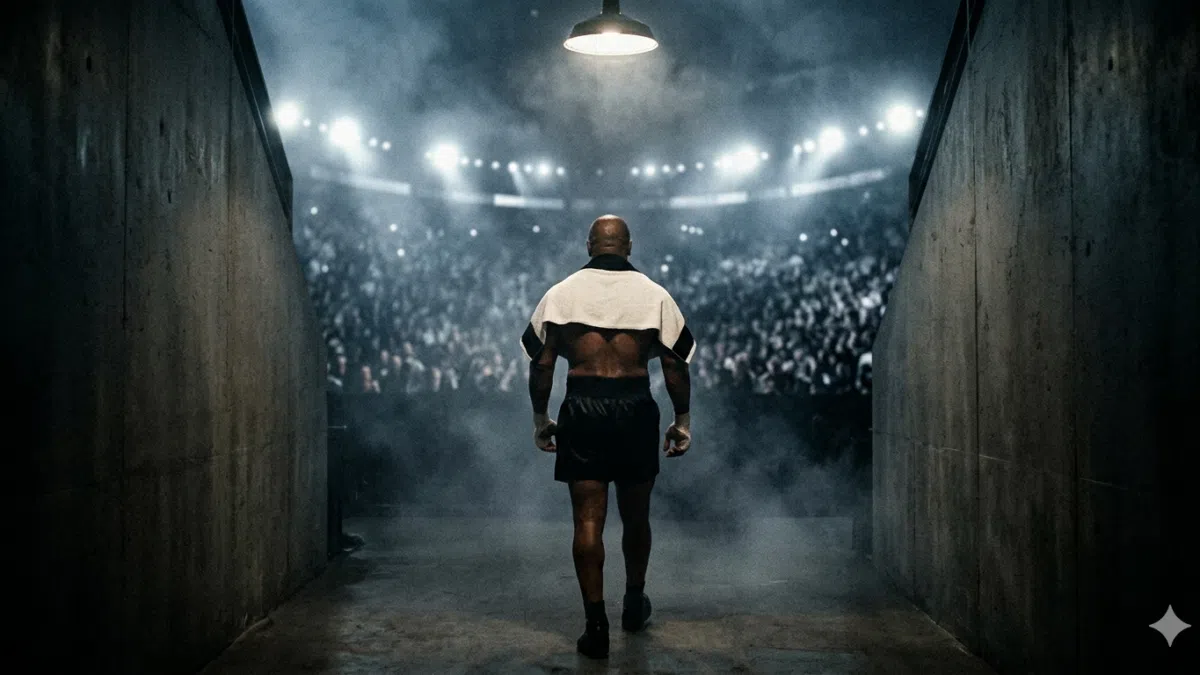
The fight starts before the bell. Every boxing fan knows this. The ring walk is the final act of theater before violence takes over, and the best ones become part of the fight’s mythology. Some entrances are designed to terrify. Others are designed to entertain. A handful managed to do both at the same time. These are the ones that stuck.
Mike Tyson vs. Michael Spinks (1988): The Gold Standard of Intimidation
No music. No robe. No entourage doing choreography. Just Mike Tyson walking through the crowd in black trunks, black boots, and a cut towel draped over his shoulders while the arena hummed with nothing but static and dread. Tyson’s entrance against Michael Spinks in Atlantic City remains the most imitated ring walk in boxing history, and nobody has ever replicated its effect. Spinks was a legitimate, undefeated light heavyweight champion who had moved up to beat Larry Holmes twice. He was not a pushover. But watching Tyson emerge from the tunnel that night, stripped of every decoration, looking like a man who had already decided the outcome, Spinks appeared to age five years before the opening bell. The fight lasted 91 seconds.
What makes the Tyson entrance iconic is its total rejection of showmanship. In a sport that rewards pageantry, Tyson understood that nothing was more terrifying than nothing. No distractions, no production, just the fighter and whatever the opponent could read in his eyes. The simplicity of it was the point. It said: I do not need any of this. You do.
Bernard Hopkins vs. Felix Trinidad (2001): The Entrance That Healed a City
Two weeks after September 11, 2001, Madison Square Garden hosted Hopkins vs. Trinidad for the undisputed middleweight championship. What happened before the fight mattered as much as what happened during it. Hundreds of firefighters filed into the Garden still wearing the dust and grime from Ground Zero. The standing ovation they received is described by those who were there as the loudest, most emotionally overwhelming moment they have ever witnessed in a sporting venue.
Then Bernard Hopkins walked to the ring in his executioner mask and robe as Ray Charles sang “America the Beautiful” over the speakers. The entire arena wept. Grown men who had spent two weeks pulling bodies from rubble clutched each other and cried openly. Hopkins, who had spent his career as the calculated villain, became something else entirely that night. He became the instrument of a city’s need to feel something other than grief. Felix Trinidad followed with a festive Puerto Rican entrance that honored his heritage and matched the moment with defiance and pride. Both fighters gave New York exactly what it needed, and Madison Square Garden proved once again why it is boxing’s spiritual home.
Hopkins stopped Trinidad in the 12th round. The fight was excellent. The entrance was transcendent.
Prince Naseem Hamed: The Man Who Turned Every Ring Walk Into a Broadway Show
No single fighter in boxing history committed more resources, creativity, and sheer audacity to the ring entrance than Prince Naseem Hamed. The Sheffield featherweight champion treated every walk to the ring as an opportunity to stage a full production number. He rode a flying carpet suspended from the ceiling against Vuyani Bungu in London in 2000. He entered on Halloween dressed as a vampire to Michael Jackson’s “Thriller.” He did front flips over the top rope. He danced. He fist bumped Puff Daddy. He made audiences wait 10 minutes before he even reached the ring apron.
The brilliance of Hamed’s entrances was that they served a dual purpose. They were entertainment, yes, but they were also psychological warfare. While his opponent stood in the ring watching this carnival unfold, the message was clear: this man does not take you seriously enough to be nervous. For a fighter who relied on unorthodox angles and supreme confidence, the ring walk was the opening salvo of the mind game. His American debut against Kevin Kelley in 1997 at Madison Square Garden featured one of the most elaborate entrances the building had ever seen. Hamed won by knockout in the fourth round after both fighters hit the canvas multiple times.
Tyson Fury vs. Deontay Wilder II (2020): Crazy Like a Fox
The choice seemed insane. Tyson Fury, walking to the ring for the biggest heavyweight fight of his career, a rematch against the most dangerous puncher in the division, chose Patsy Cline’s “Crazy” as his entrance song. Not a hip hop anthem. Not heavy metal. A wistful 1961 country ballad sung by a woman who died at 30 in a plane crash.
Fury walked slowly, deliberately, dressed in an elaborate throne-like costume, and the song’s gentle melody created a surreal contrast with the violence that was about to unfold. It felt like watching a man who had already won the fight in his own mind and was simply taking a pleasant stroll to collect the belt. Some observers found it uncomfortably relaxed given the stakes. Then Fury walked into the ring and systematically dismantled Wilder in seven rounds, leaving no doubt about who the better heavyweight was. The song choice, in retrospect, was either the product of supreme confidence or genuine eccentricity. With Fury, the answer is probably both.
Chris Eubank Sr. vs. Nigel Benn II (1993): Simply the Best on a Harley
Chris Eubank Sr. understood theater the way few British fighters ever have. For his epic rematch with Nigel Benn at Old Trafford in Manchester, Eubank rode to the ring on a Harley Davidson motorcycle while Tina Turner’s “Simply the Best” blasted through the stadium. The crowd, overwhelmingly hostile to Eubank, booed relentlessly. Eubank could not have cared less. That was always the point with him. The monocle, the lisp, the aristocratic posture, the motorcycle, all of it was designed to communicate that he existed on a plane above the emotions of the crowd. Benn’s fans wanted to rattle him. Eubank wanted them to know they could not.
The fight was a draw, which felt about right. Neither man would give an inch inside the ring, just as Eubank refused to give an inch during his entrance. Years later, Eubank’s ring walks remain some of the most discussed in British boxing history.
Floyd Mayweather vs. Oscar De La Hoya (2007): Maximum Provocation
Floyd Mayweather has produced dozens of memorable ring walks over his career. He has brought 50 Cent, Lil Wayne, and Justin Bieber along for the trip. He has been carried on thrones and entered in gladiator costumes. But the one that crystallized his genius for provocation was his entrance against Oscar De La Hoya in 2007. The fight took place on Cinco de Mayo weekend, the biggest night on the boxing calendar for Mexican and Mexican-American fans. De La Hoya, of Mexican heritage, was the crowd favorite. Mayweather walked out wearing a sombrero and the colors of the Mexican flag.
It was outrageous. It was calculated. And it worked. The crowd directed every ounce of hostility toward Mayweather, which is exactly where he wanted it. “Pretty Boy” had already begun his transition into “Money,” and he understood that in boxing, hatred sells just as well as admiration. He won a split decision in a fight that generated over $130 million in pay-per-view revenue. The sombrero was worth every boo.
Wladimir Klitschko vs. David Haye (2011): The Quiet Man’s Revenge
Wladimir Klitschko was not a showman by nature. The Ukrainian heavyweight was clinical, cerebral, and methodical in everything he did. But David Haye had spent the buildup to their fight making it deeply personal, including comments that reportedly offended Klitschko’s mother. So for the first and perhaps only time in his career, Klitschko decided to make a statement with his entrance.
He left Haye waiting in the ring for nearly 10 minutes. When he finally emerged, it was with fireworks, a theatrical video package that included footage of Klitschko promising to knock Haye out, a cameo from legendary heavyweight George Foreman, and the Red Hot Chili Peppers’ “Can’t Stop” pumping through the speakers. The message was unmistakable: I do not normally do this, but you have earned it. Klitschko dominated the fight over 12 rounds. Haye blamed a broken toe. The entrance needed no excuses.
Muhammad Ali vs. Earnie Shavers (1977): Star Wars and the Greatest
Before entrance music became a standard part of the boxing production, Muhammad Ali walked to the ring against Earnie Shavers to the opening theme from “Star Wars.” The film had been released just months earlier and was already a cultural phenomenon. Ali, who understood spectacle better than any athlete who ever lived, heard the music and knew it was his. The sweeping orchestral score fit a fighter who had always seen himself as the hero of an epic story. It was strange. It was perfect. And it was years ahead of its time.
Ali won by unanimous decision against one of the hardest punchers in heavyweight history, surviving a brutal 15th round in the process. But the image of the Greatest walking toward the ring with John Williams’ score swelling behind him endures as one of the earliest examples of a fighter understanding that the walk is part of the show.
Deontay Wilder vs. Tyson Fury I (2018): The Costume That Launched a Thousand Memes
You cannot write about great ring walks without mentioning the ring walk that became more famous than the fight for all the wrong reasons. Deontay Wilder’s entrance for his first fight against Tyson Fury featured an elaborate, battery-powered LED costume that looked like it belonged in a Marvel film. The crowd loved it. The spectacle was undeniable.
The problems came later. After Wilder lost the rematch decisively, he blamed the costume, claiming it weighed approximately 40 pounds and had exhausted his legs before the fight even started. It was an excuse that launched a thousand memes and will follow Wilder for the rest of his career. The lesson: if you are going to make your ring walk the centerpiece of the evening, you had better win the fight. Otherwise, the entrance becomes the story, and not in the way you wanted.
Why the Ring Walk Still Matters
In an era when boxing competes with every form of entertainment on earth for attention, the ring walk remains one of the sport’s unique advantages. No other competition gives an athlete three uninterrupted minutes to establish a narrative before the action begins. The wildest moments in boxing often start before the first bell, and the best entrances become inseparable from the fights they preceded.
Tyson proved that silence could be the loudest entrance of all. Hamed proved that absurdity could be a weapon. Hopkins proved that an entrance could mean something larger than the sport itself. And Wilder proved that if the costume is heavier than your excuse, you have a problem. The ring walk is boxing’s opening argument. The best fighters have always known how to make it count.