
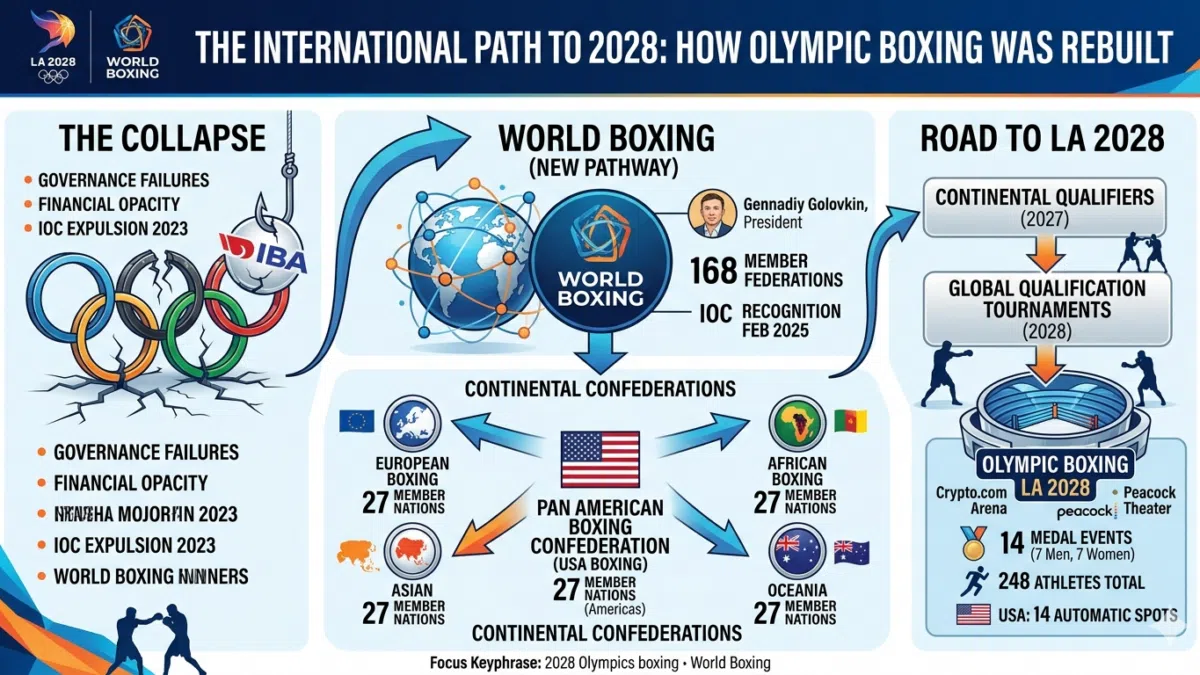
In the first installment of this series, we followed the pathway from a neighborhood gym to USA Boxing’s High Performance program in Colorado Springs. That is where the domestic road ends and the international road begins. For an American fighter with Olympic ambitions, the journey from this point forward runs through a governing structure that did not exist three years ago.
Boxing nearly lost its place in the Olympic Games. Understanding why — and how a replacement was built from scratch — is essential for any fighter, coach, or fan trying to make sense of the road to Los Angeles 2028.
Why the Old System Collapsed
For most of its history, international amateur boxing was governed by a single organization: the International Boxing Association, known as AIBA and later rebranded as the IBA. Founded in 1920, it was the body that sanctioned Olympic boxing, ran World Championships, and oversaw national federations in nearly 200 countries.
By the late 2010s, the IOC had lost confidence in the IBA over a series of escalating concerns — governance failures, financial opacity, questions about the integrity of judging and officiating, and growing ties between the organization’s leadership and the Russian government. The IOC suspended the IBA in 2019 and took the extraordinary step of running the boxing competitions at the Tokyo 2020 and Paris 2024 Olympics itself, through specially created task forces. In June 2023, the IOC permanently expelled the IBA — the first international federation in Olympic history to be removed from the movement.
Boxing was left off the initial LA 2028 program entirely. The IOC made clear that unless the sport’s national federations built a new, credible international governing body, boxing would not be part of the Games.
World Boxing
In April 2023, a group of national federations launched World Boxing as a replacement. USA Boxing was the first national federation in the world to leave the IBA and join the new organization. Great Britain, Canada, and others followed quickly. The effort was driven by a coalition called the Common Cause Alliance — federations that had been pushing for transparency and reform within the IBA before concluding that reform from within was impossible.
World Boxing started with 27 member nations. By the time it held its first formal meeting with the IOC in May 2024, it had grown significantly. In February 2025, the IOC granted World Boxing provisional recognition as the international federation governing Olympic boxing. The following month, at the 144th IOC Session in Greece, boxing was unanimously reinstated on the LA 2028 program.
As of early 2026, World Boxing has 168 member national federations — including, notably, recent applications from Russia and Belarus, who would compete as Individual Neutral Athletes under the same framework used at the 2026 Milan Cortina Winter Olympics. The organization is now led by former two-time middleweight world champion and 2004 Olympic silver medalist Gennadiy Golovkin, who was elected president at the November 2025 congress in Rome.
The Continental Confederations
Beneath World Boxing sit five continental confederations — the regional governing bodies that organize competitions, develop athletes, and manage the sport across their geographic areas. For an American fighter, the relevant body is the Pan American Boxing Confederation.
The Pan American Boxing Confederation was established in January 2025 and held its inaugural congress in Panama City on March 15, 2025. It was founded by 17 national federations from the Americas that were members of World Boxing, and has since grown to 27 member nations spanning North America, Central America, South America, and the Caribbean. In August 2025, the confederation was officially recognized by the Association of Panamerican Sports Confederations (ACODEPA).
The other four continental bodies are European Boxing (inaugurated in Prague, March 2025), Asian Boxing (formed in December 2024), the African Boxing Confederation, and Oceania Boxing (established in Fiji, October 2025). Each confederation organizes its own competition calendar and will play a direct role in Olympic qualification.
The LA 2028 Boxing Competition
The boxing competition at the 2028 Los Angeles Olympics will feature 14 medal events — seven for men and seven for women. This represents the first time in Olympic history that boxing will have full gender parity in weight classes. At Paris 2024, there were seven men’s divisions and six women’s; the addition of a seventh women’s class for LA 2028 closes that gap.
The confirmed weight classes:
Men: 55kg, 60kg, 65kg, 70kg, 80kg, 90kg, +90kg
Women: 51kg, 54kg, 57kg, 60kg, 65kg, 70kg, +80kg
A total of 248 athletes will compete — 124 men and 124 women. The United States, as the host country, is allocated 14 automatic quota places: one per weight class for both men and women, provided the athletes meet eligibility requirements. The remaining spots will be earned through the qualification pathway.
Preliminary bouts will be held at the Peacock Theater. Finals will take place at Crypto.com Arena.
The Qualification Pathway
World Boxing is responsible for organizing the entire LA 2028 qualification system. While the specific calendar has not been finalized, the framework is taking shape based on IOC guidelines and the precedent set by previous Olympic cycles.
Qualification is expected to run through three tiers. Continental qualification events — organized by each of the five confederations — will offer the first opportunities to secure Olympic berths. In Europe, the 2027 European Games will serve as the continental qualifier. Events in the Americas, Africa, Asia, and Oceania are expected to follow a similar structure, with the Pan American Championships likely serving as the primary continental qualifier for fighters in the Western Hemisphere.
Two global Olympic qualification tournaments are expected in the first and second quarters of 2028, offering remaining spots to fighters who did not qualify through their continental events.
A universality program will also provide 10 additional places, allocated by the IOC’s Tripartite Commission after the qualification period closes, to ensure broad global representation.
One critical rule: only athletes whose national federations are members of World Boxing by the start of the qualification period will be eligible to compete for Olympic spots. This is what gives World Boxing’s membership rolls their weight — for a fighter to have any path to the Olympics, their country must be in the system.
What This Means for American Fighters
For a fighter coming through the USA Boxing pipeline — through the Ring Masters Championships, the National Golden Gloves, and the High Performance program — the international calendar is now the proving ground. The 2026 schedule features World Boxing Cup events in Brazil, tournaments in Bulgaria, Finland, the Netherlands, and Pan American Championships in Mexico. These are the competitions where fighters build their international records, earn rankings, and position themselves for Olympic qualification events in 2027 and 2028.
The United States has 14 guaranteed spots by virtue of being the host nation. But guaranteed spots still require athletes who can fill them. The High Performance program in Colorado Springs exists to identify and develop those athletes. The international events over the next two years exist to test them against the world’s best.
The road from a qualifying bout at a local gym to the Olympic podium at Crypto.com Arena passes through every organization covered in this series — USA Boxing, the LBCs, the Golden Gloves, the High Performance program, World Boxing, the Pan American Boxing Confederation, and the continental qualification system. None of those pieces existed in their current form five years ago. All of them are now in place. The clock to LA 2028 is running.