
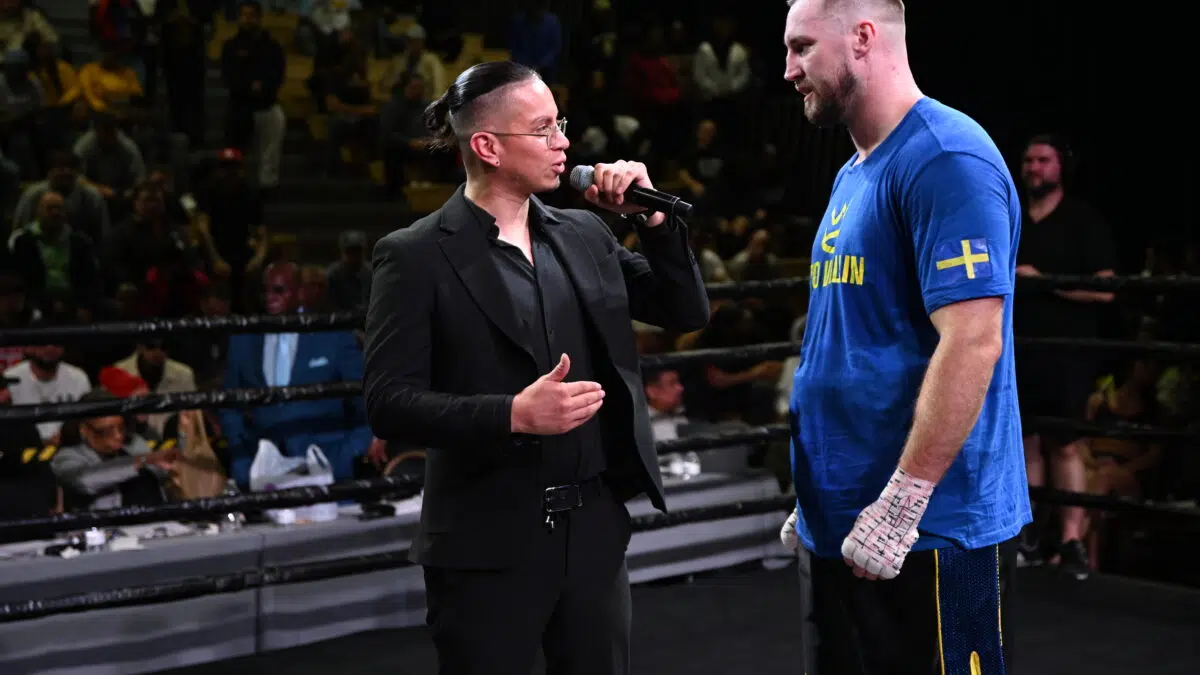
Henry DeLeon never planned on becoming a boxing trainer. He walked into Mendez Boxing Gym in Manhattan as a guy who wanted to train on Saturdays, and the rest happened the way most real things in boxing happen — by accident, by proximity, and by showing up when somebody else did not.
Today, DeLeon is an assistant trainer at Salas Boxing Academy in Las Vegas, working under the legendary Cuban coach Ismael Salas. He has worked the corners of world champions and been sent out alone to call shots on big cards. The man who mentored him — a trainer who has developed Olympic gold medalists and world titleholders across five decades — has called him a master strategist. DeLeon is 30 years old. He has been in Las Vegas for a little over two years. Before that, he was sweeping floors.
The Elevator Pitch
DeLeon had been training at Mendez for about two weeks when he found himself riding the elevator down with Francisco Mendez, the gym’s founder. He took a shot.
“I asked him, do you by any chance need anybody to work here to help you clean the gym or something, in exchange for letting me come train more often?” DeLeon recalled. “He said yeah, come to the gym on Tuesday and speak to Susana. And we’ll go from there.”
He got the deal. He cleaned. He trained. Then one day a coach did not show up, and Mendez told DeLeon to get on the floor and work with clients. That led to fitness classes, then assisting Moses Sanchez with white-collar boxers, then amateur fighters. DeLeon was getting better at something he had never set out to do.
Along the way, he fell into another orbit that sharpened a different set of skills. DeLeon became a fixture at BoxingInsider.com — first as a photographer, then as a co-host on the Boxing Insider Radio podcast, then as a commentator on the site’s live fight broadcasts. He served as the personal trainer for the site’s owner. On a night when the camera operators did not show up, he ran the camera. If there was a job that needed doing, DeLeon did it — and if keeping the promoter out of trouble counts as a job, he did that too, though he would be the first to tell you the results were mixed.
The real shift came during COVID, when another coach asked DeLeon to help train a professional fighter. It was the first time he had worked at that level, and it rewired his ambition. But he felt there was no one in New York whose mentorship could take him where he needed to go. A friend training with Ismael Salas in Vegas asked if DeLeon could come shadow for a month. Salas said yes.
“It was supposed to be just for a month,” DeLeon said. “That month became two months, three months, six months. Next thing I know, I’m out here for more than two years and counting.”
The School of Salas
Ismael Salas is a former head coach of the Cuban national boxing team who has trained world champions including Guillermo Rigondeaux, Jorge Linares, Yuriorkis Gamboa, Yordenis Ugas, Kazuto Ioka, and Carlos Adames. He was named WBA Trainer of the Year in 1996 and has spent more than four decades developing fighters at every level of the sport.
DeLeon describes himself as still being in school — not the head trainer, not running the show. But the responsibilities have grown, and Salas now sends him to lead corners at major fights on his own. The trust was earned in a specific moment: a fight in Orlando roughly two years ago, DeLeon’s first time working a corner alongside Salas. He spotted a small adjustment. He told Salas. Salas applied it. The difference showed immediately.
“Over time, he’s grown to trust and understand that I do have a pretty good knowledge of what I’m talking about when working the corner,” DeLeon said. Then came the compliment he did not expect — Salas called him a master strategist. “Coming from someone like him, someone that I’ve idolized in the boxing world — for him to give me a compliment like that, I think that speaks a lot. That’s what I was missing in New York. I didn’t have someone I respected enough, who had accomplished enough in the sport, to give you that kind of validation.”
Haymakers for Hope
For all the world title experience DeLeon has accumulated, one of the things he talks about with the most enthusiasm has nothing to do with championship belts. Haymakers for Hope is a nonprofit that stages sanctioned charity boxing events to raise money for cancer research, with over $25 million raised since 2009 across events in Boston, New York, Philadelphia, and Miami. The participants are everyday people — many with no boxing experience — who sign up because cancer has touched their lives.
DeLeon works as a matchmaker for Haymakers events, pairing first-time fighters of similar size, age, and ability. “You don’t want to ruin someone’s experience by putting them in a situation where they can’t defend themselves,” he said. “A lot of these people find out for the first time what boxing really is when they sign up. They’ve been impacted by cancer, and this is their way of fighting back.”
It is the kind of work that keeps a young trainer grounded — a reminder that boxing is not always about titles and purses. Sometimes it is about two people who have never thrown a punch stepping into a ring because they lost someone, and they needed to do something about it.
What Comes Next
DeLeon does not hide his ambition. He wants to be considered one of the best coaches to come out of New York City — a statement that puts him in conversation with names that carry decades of history and championship hardware.
“I’m in school at the moment, under the guidance of Ismael Salas,” DeLeon said. “But that is the ultimate goal — to eventually get to a point where I could be considered one of the best coaches to come out of NYC.”
He came to Las Vegas with a one-month plan. Two years later, he is studying under one of the sport’s most decorated trainers, working corners on world title cards, and matchmaking charity fights for cancer survivors in his spare time. The guy who never planned on training anyone is building a career that looks increasingly difficult to ignore.