The TKO-backed bill is headed for a House floor vote. Here’s what every small promoter needs to understand.
By Larry Goldberg and BoxingInsider Staff
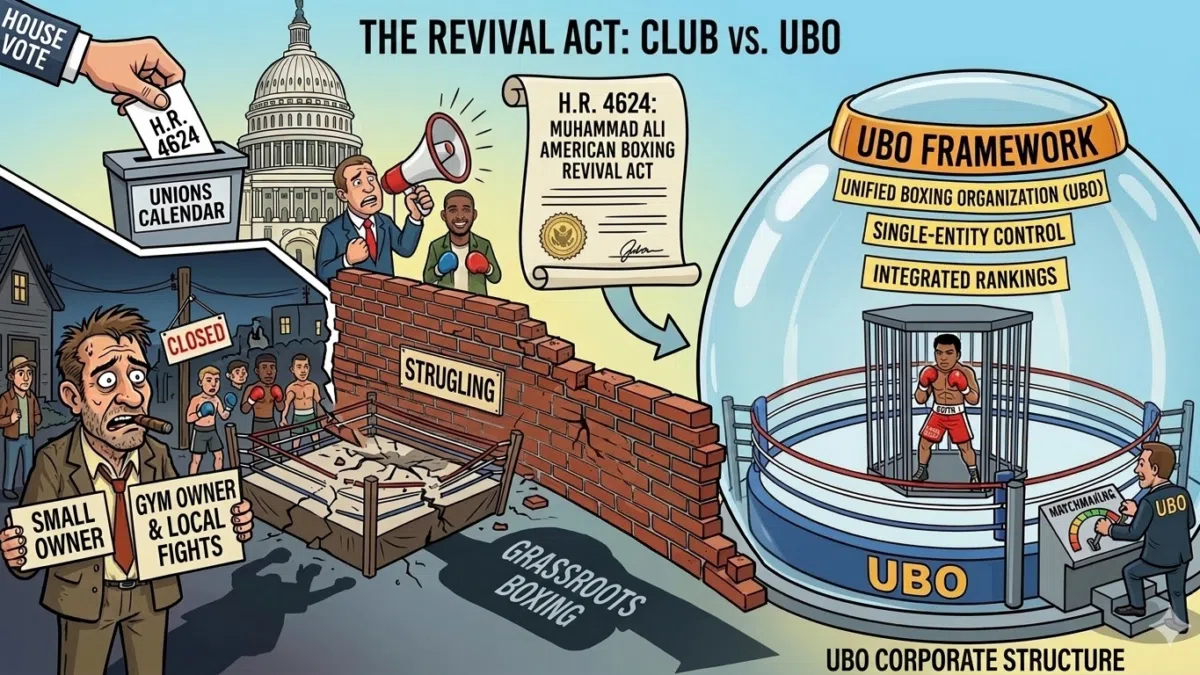
The Muhammad Ali American Boxing Revival Act (H.R. 4624) is on the Union Calendar and headed for a full vote on the floor of the U.S. House of Representatives. The final committee report (H. Rept. 119-524) was posted on March 10, the Committee on Energy and Commerce has been discharged, and the bill has now cleared every committee hurdle. It passed the House Education and Workforce Committee 30–4 in January with strong bipartisan support, and its sponsors are pushing for passage by mid-2026. If it clears the House, it moves to the Senate, then to President Trump’s desk.
The bill has been framed as a modernization effort — better pay for fighters, stronger medical protections, a new framework to revive American boxing. Those talking points sound good in a press release. But for the hundreds of independent and club-level promoters who actually keep the sport alive at the grassroots level across the United States, this legislation could be an extinction event.
What the Bill Creates: The UBO Framework
The centerpiece of the Ali Revival Act is the creation of Unified Boxing Organizations, or UBOs. A UBO would be a single entity authorized to promote events, issue its own rankings, and award championship titles — all under one corporate roof. Fighters would have the option to compete under the traditional sanctioning body system (WBC, WBA, IBF, WBO) or sign with a UBO instead.
The bill’s sponsors describe this as giving fighters “more choice.” What it actually does is dismantle the firewall between promoters and sanctioning bodies that has been the foundation of federal boxing law since the original Ali Act was passed in 2000. That law was specifically designed to prevent a single entity from controlling matchmaking, rankings, and titles simultaneously. The Revival Act removes that separation.
TKO Group Holdings — the parent company of the UFC and WWE — has been the primary driver of this legislation. TKO and Saudi Arabia’s Public Investment Fund subsidiary Sela launched Zuffa Boxing in 2025, and Zuffa staged its first event in January 2026 at the Meta Apex in Las Vegas. The timing is not a coincidence. The bill would give Zuffa Boxing a legal framework to operate in American boxing the same way the UFC operates in MMA: controlling the talent pipeline, the titles, the matchmaking, and the economics. (For a full breakdown of TKO’s corporate structure, see Does The Boxing Industry Really Understand Who TKO / Zuffa Boxing Is?)
The “Nothing Will Change” Claim
Supporters of the bill have repeatedly insisted that the existing sanctioning body system will continue to operate alongside UBOs, and that nothing in the current structure will be altered. This is technically true and practically meaningless.
The bill does not abolish the WBC, WBA, IBF, or WBO. But it creates a parallel system with no mechanism to prevent promoters, broadcasters, and fighters from migrating entirely to UBOs once they are established. If a UBO can offer fighters guaranteed monthly compensation, training facilities, medical insurance, and a clearer path to title fights — all backed by billions of dollars in corporate and sovereign wealth fund capital — the traditional system doesn’t get “replaced.” It gets starved.
And while the bill technically applies to any organization that registers as a UBO, the barrier to entry is enormous. The requirements — training facilities, insurance programs, anti-doping infrastructure, certified ringside physicians — are built for a well-capitalized corporate operation. They are not built for a promoter running four shows a year at a casino ballroom.
When Rep. Ilhan Omar pressed TKO directly on this point in her Questions for the Record following the December 2025 subcommittee hearing, the company’s written response was revealing. Omar asked how many UBOs TKO realistically expected to form in the first five years, and whether TKO would commit to not demanding exclusivity in media rights or venue contracts that would make it commercially impossible for rival UBOs to compete. TKO declined to answer the exclusivity question directly and pointed to the MMA industry — where the UFC holds dominant market share — as evidence that competitors could emerge.
Omar also asked TKO to explain why it needed this legislation at all, given that nothing in current law prevents Zuffa Boxing from operating. TKO’s answer: that “ambiguity” in the existing Ali Act creates uncertainty about whether certain provisions apply to their model. In other words, the current law’s protections might apply to them, and they’d rather they didn’t. (BoxingInsider.com published a full breakdown of TKO’s responses to Rep. Omar’s Questions for the Record.)
The Provision That Could End Club Boxing: Mandatory Drug Testing
Most of the Ali Revival Act’s cost mandates — minimum fighter pay, medical coverage, ringside safety requirements — are already standard in well-regulated states like New Jersey and New York. But one provision could single-handedly kill club boxing in America: mandatory WADA-level drug testing.
The anti-doping amendment requires random testing for all title fights and at least 50 percent of the remaining participants on any given show. Testing must screen for every substance on the current World Anti-Doping Agency banned list. When the amendment was adopted, the immediate reaction from the boxing industry was blunt: this will all but kill the U.S. club boxing scene.
The reason is money. A single sample collection by a reputable anti-doping agency costs between $600 and $1,200 just for the collection — before the lab even touches it. A full-panel WADA-compliant analysis runs significantly higher. According to the Voluntary Anti-Doping Association (VADA), the standard cost of a pre-fight testing program is approximately $10,000 per fighter for an eight-to-ten-week window. Matchroom Boxing’s Eddie Hearn has stated publicly that VADA testing runs between $20,000 and $30,000 per fight — covering both fighters — and flatly called it impossible to test an entire card. Even the ABC’s own president, Mike Mazzulli, has acknowledged that drug testing is an extraordinary expense most boxing promoters simply cannot afford.
Now apply those numbers to a typical club show. Take an eight-bout card with 16 fighters. The bill requires testing of at least 50 percent of participants — that’s eight fighters minimum. Even at the lowest possible collection-only rate, you’re looking at $4,800 to $9,600 just for specimen collection. Once you factor in WADA-compliant laboratory analysis, the realistic cost lands somewhere between $12,000 and $20,000 per show — and that’s a conservative estimate. For context, that could exceed the entire net revenue of many club-level events.
For TKO, $20,000 in drug testing is a rounding error. For a regional promoter staging four or five shows a year, it is potentially the difference between staying in business and shutting down. There is no sliding scale. There is no exemption for small shows. The bill applies the same testing mandate to a Zuffa Boxing event at the Meta Apex in Las Vegas and an eight-bout card at a casino ballroom in Atlantic City.
The bill’s other cost mandates — a $200-per-round minimum, $50,000 in medical coverage per bout, two ambulances and two doctors at ringside — are already standard practice in well-regulated states like New Jersey and New York. They’ll squeeze promoters in states with weaker requirements, but they’re not the existential threat. What compounds the damage is Rep. Omar’s amendment requiring UBOs to either arrange at least one fight for contracted boxers every six months or pay a guaranteed $2,000 per month during any period of inactivity. It’s framed as a protection against fighters being benched. In practice, it means any organization operating under this framework needs the cash reserves to carry an entire roster on monthly payroll between events. That’s TKO math, not club promoter math.
Who Actually Asked for This?
The bill’s supporters include TKO Group, Lonnie Ali (widow of Muhammad Ali), and the Association of Boxing Commissions. But the ABC’s endorsement may be the most misleading talking point in the entire campaign for this bill. The ABC’s own general counsel, Pat English — one of the original drafters of both the Professional Boxer Health and Safety Act and the Muhammad Ali Boxing Reform Act — submitted a formal letter to Congress calling the Revival Act a “betrayal” of everything the original legislation was designed to do.
English wrote that the bill was substantially drafted by TKO’s lobbyists to benefit a single entity and that it destroys the firewall between promoters and sanctioning bodies that he personally helped build. The man who wrote the Ali Act is telling Congress this bill guts it. And the organization he serves as general counsel claims to support it.
The reason for that contradiction is that the ABC is at war with itself. Reporting by The MMA Draw has documented that opposition to the bill inside the ABC is large but lacks a loud megaphone. The fault line runs between leadership — figures like Andy Foster at the California commission, former president Mike Mazzulli, and current president Tim Shipman — and the rank-and-file membership. Multiple commissioners have told industry contacts they are unable to speak freely on the matter. Colorado’s commission came out in opposition in November 2025. Characterizing the ABC’s position as representing the unified views of the American regulatory community is flatly inaccurate.
Then there’s Mike Tyson, listed as a supporter since the bill’s introduction. When asked about the legislation on The Ariel Helwani Show in March 2026, Tyson offered this: “We shouldn’t tell people who to go with. We should allow them to choose who to go with.” He did not mention the bill by name, did not reference UBOs, and did not engage with a single specific. When the bill’s highest-profile celebrity endorsement cannot articulate what it actually does, that tells you something about how deep the support really goes.
The opposition is broader and deeper than any press release has acknowledged. The World Boxing Council. Oscar De La Hoya. Lou DiBella. Eddie Hearn. Evander Holyfield, who wrote a Wall Street Journal op-ed warning that UBOs would allow a company to control every part of boxing. The MMA Fighters Association, which circulated a petition calling the bill an extension of the UFC’s monopoly model. Nico Ali Walsh, Muhammad Ali’s own grandson, who stated publicly that his grandfather would never have supported this legislation. And Rep. Brittany Pettersen of Colorado, who submitted a letter to Congress supporting the opposition effort.
Perhaps most significantly, USA Boxing — the national governing body for amateur boxing and the gatekeeper of the amateur-to-professional pipeline — withdrew its support in late February 2026. The organization’s board determined that an earlier endorsement letter had not been formally authorized. The reversal came after UFC CEO Dana White and WWE president Nick Khan had appeared at USA Boxing’s national championships in December 2025, scouting amateur talent for Zuffa Boxing. TKO wanted to lock up the pipeline from amateur development through professional promotion. When that arrangement fell apart, so did the endorsement.
The UFC Precedent No One Should Ignore
The concern about TKO’s intentions is not theoretical. The UFC model concentrates promotion, matchmaking, and title control under a single entity. Fighters compete exclusively under the UFC banner. The promotion sets the terms.
In 2024, UFC reached a $375 million settlement to resolve allegations brought by former fighters who claimed the promotion had suppressed their wages through its control of the sport. A second case remains pending. Combat sports attorney Erik Magraken has argued that the independence of rankings and titles in boxing is the single biggest reason boxers earn significantly more than MMA fighters at comparable levels. The Ali Revival Act would remove that independence.
There is another dimension to the UFC precedent that deserves attention: the Ali Revival Act may function as a quasi-antitrust exemption for TKO. If Congress explicitly authorizes the UBO model — a structure in which a single entity controls promotion, rankings, and titles — it becomes extraordinarily difficult for anyone to later sue that entity for antitrust violations arising from doing exactly what Congress told them they could do. Someone will inevitably try. But this bill could give TKO the legal shield it never had in MMA, where the $375 million settlement happened precisely because there was no congressional authorization for the UFC’s monopolistic structure. The Ali Revival Act doesn’t just change boxing’s business model. It may immunize the company running it.
For independent promoters, the danger is not just about competing with a UBO for talent. It is about what happens to the broader ecosystem once the UBO model is established. If fighters migrate to the UBO system for guaranteed pay and benefits, the pool of available talent for club shows shrinks. If the UBO system consolidates broadcast relationships, independent promoters lose access to the distribution channels that keep their businesses viable. The bill doesn’t need to ban independent promotion. It just needs to make it economically impossible.
What Happens Next
The bill is awaiting a House floor vote. Given the bipartisan committee support and TKO’s strong ties to the Trump administration, the odds of passage are real.
There may be further amendments before the floor vote — Democratic ranking member Bobby Scott has pushed for continued improvements — but the core architecture is unlikely to change.
And even beyond the direct regulatory impact, the UBO model will reshape how boxing gets financed. What TKO has built with Silver Lake, Mubadala, and Saudi sovereign wealth fund capital is not just a promotion — it’s an institutional investment template. Once the UBO framework becomes law, financiers and investors looking at boxing will expect to see that kind of apparatus before writing checks. The days of a regional promoter walking into a meeting with a business plan and a handshake are numbered. The UBO structure creates a one-size-fits-all financing model, and if you don’t fit, the money goes elsewhere. For club promoters who have always operated on relationships, personal capital, and local sponsorships, the capital markets just moved even further out of reach.
For club promoters and independents, this bill was not written with you in mind. It was written to create a legal framework for a billion-dollar corporation to enter boxing on its own terms. Everyone else is collateral damage.
BoxingInsider.com is an independent boxing news platform and the home of Boxing Insider Promotions, which stages professional boxing events in Atlantic City and New York City. We are not covering this legislation from the outside. We are one of the promoters it will directly affect.
Larry Goldberg is the owner of Boxing Insider and promoted 20 club shows in NJ and NY. This is the first in a multi-part series examining the Ali Revival Act and its impact on professional boxing from the gas roots level.