
By Boxing Insider Staff
The Muhammad Ali American Boxing Revival Act (H.R. 4624) passed the U.S. House of Representatives today by voice vote. It is the first boxing legislation to clear the House in 26 years.
The bill now moves to the Senate, where it will need 60 votes to overcome a filibuster. The senator who controls whether it gets there is Ted Cruz of Texas, chairman of the Senate Committee on Commerce, Science, and Transportation.
What Happened Today
The House brought H.R. 4624 to the floor under Suspension of the Rules, which limits debate to 40 minutes, prohibits amendments, and requires a two-thirds supermajority. The bill passed by voice vote. No member forced a recorded roll call.
The bill was introduced in July 2025 by Rep. Brian Jack (R-GA) and Rep. Sharice Davids (D-KS) and passed the House Education and Workforce Committee 30 to 4 in January 2026. The legislative text was revised on March 17, one week before today’s floor vote.
Congressman Jack called it “landmark boxing legislation that will revive one of America’s greatest sports in the name of one of America’s greatest athletes.”
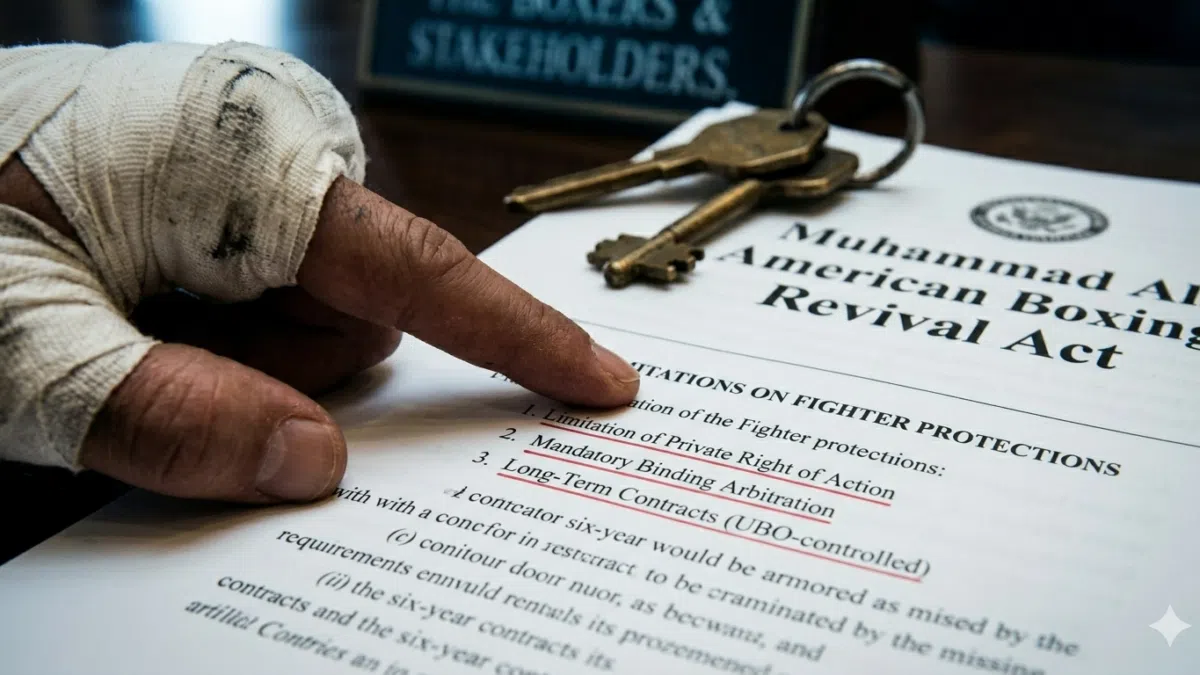
Rep. Joe Courtney (D-CT) was the only member of the House to speak against the bill on the floor. Courtney warned that the UBO structure would allow promoters to use coercive long-term contracts, forced arbitration, and class-action waivers modeled on the UFC. He entered letters into the record from USA Boxing, which withdrew its endorsement, and from a Top Rank attorney who called the bill damaging to fighters’ legal rights. He was the only one who stood up.
What the Bill Does
H.R. 4624 creates a new entity called a Unified Boxing Organization, or UBO, which could handle promotion, rankings, titles, and sanctioning under one structure. Fighters would choose between the existing sanctioning body system or the UBO framework.
The bill establishes a $200 per round minimum payment for all professional boxers, $50,000 in medical coverage per bout, $15,000 in accidental death coverage, certified ringside physicians, and anti-doping requirements. Those provisions apply to all of professional boxing, not only UBO events.
Lonnie Ali said she looks forward to “working with the Senate to ensure this bill becomes the very best bill possible for fighters and the sport of boxing.” Bob Arum, the Hall of Fame promoter who promoted Muhammad Ali, identified three specific Ali Act protections the bill removes for fighters who sign with a UBO: safeguards against coercive contracts, financial disclosure requirements, and the firewall separating promoters from managers. Those three provisions were the structural foundation of the original law.
The bill also grants the Association of Boxing Commissions new federal authority over physician certification and referee approval, effectively positioning the ABC as a de facto national regulatory body without the accountability of a federal commission.
Supporters include the ABC, Lonnie Ali, Mike Tyson, the Teamsters, and major arena operators including MSG and MGM Resorts. Opponents include Bob Arum, Oscar De La Hoya, Evander Holyfield, the WBC, and the MMA Fighters Association. USA Boxing withdrew its endorsement in late February. TKO Group Holdings, parent company of the UFC and WWE, lobbied for the bill and launched Zuffa Boxing in anticipation of its passage.
The Senate: Ted Cruz and the Commerce Committee
The Senate Committee on Commerce has jurisdiction over interstate commerce, the constitutional basis for federal boxing law. The original Ali Act was written and passed through this same committee under Senator John McCain.
Today the committee is chaired by Ted Cruz. Cruz has not made a public statement on H.R. 4624. But on March 17, the same day the revised legislative text was posted, Dana White appeared on Cruz’s podcast “Verdict with Ted Cruz” for a wide-ranging interview covering boxing, the UFC, and their mutual relationship with President Trump. If the bill is referred to his committee, Cruz decides whether to hold hearings, advance it, or let it sit.
The Senate has historically moved slowly on boxing. The original Ali Act was blocked in the upper chamber in 1998 by an anonymous hold before passing two years later.
What Comes Next
Supporters say the bill is overdue. Boxing has not had a federal update in 26 years, marquee fights have moved overseas, and the regulatory patchwork across states is inconsistent.
Critics point to the process. The original Ali Act took two congressional sessions, multiple Senate hearings, and testimony from every corner of the sport. H.R. 4624 had one hearing, was voted out of committee before TKO’s written answers to members’ questions were received, and reached the floor under a procedure that prohibited amendments. Cutmen, ringside physicians, matchmakers, managers, active fighters, and state commissioners were not heard.
Two members who voted for the bill, Rep. Bobby Scott (D-VA) and Rep. Ilhan Omar (D-MN), publicly called on the Senate to strengthen protections against coercive contracts, forced arbitration, and monopoly provisions before passage.
Whether the Senate provides the debate the House did not is now the central question.