
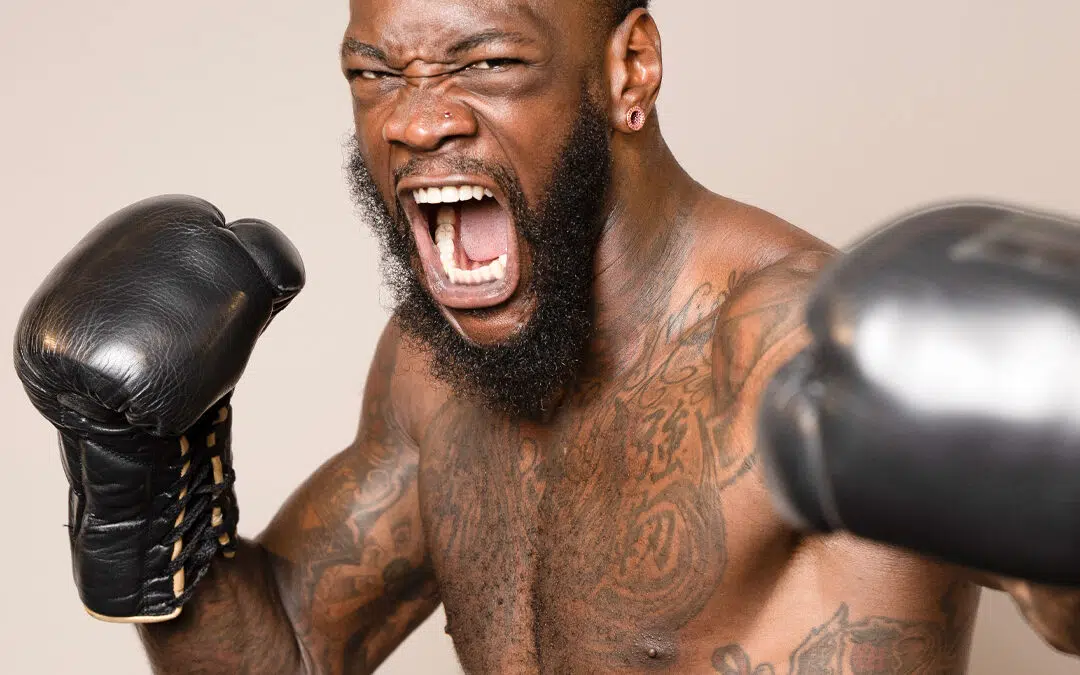
There is a moment from this week in London that tells you everything you need to know about Deontay Wilder. He had just stormed out of a talkSPORT interview after Simon Jordan pressed him on the Tyson Fury cheating allegations, cursing his way out of the building while security stepped between him and the host. Hours later, at the official press conference, Wilder spotted veteran promoter Frank Warren waiting backstage. He picked the 74 year old up off the ground, squeezed him like a long lost relative, and scrunched Warren’s freshly pressed suit in his massive arms. Warren, a man who has seen everything the sport can produce, smiled like a kid.
Two versions of the same man, separated by a few hours and a change of scenery. That duality has defined Wilder’s entire career. It is the reason people still pay to watch him fight at 40, and the reason fight week with the Bronze Bomber remains appointment viewing even when the record no longer cooperates. He is one of the last heavyweights who understands, instinctively and without coaching, that the division has always been as much about spectacle as sport.
The Switch
Wilder sat down with ESPN during fight week in London, his jacket embroidered with the phrase “Better with Age, Aged to Perfection.” He spoke about having to reconstruct himself, about putting the pieces back together mentally, physically, and emotionally after the losses that reshaped how the world sees him. He said he has not felt this excited heading into a fight in a long time. His tone was measured. His energy was calm. He sounded like a man who had made peace with something.
That same day, Jordan had tried to get Wilder to account for years of accusations aimed at Fury, claims about tampered gloves and spiked water that have followed him since the trilogy ended in 2021. Wilder told Jordan the segment was about Derek Chisora, not Fury. Jordan pushed. Wilder’s voice climbed. He stood up from his chair, advanced toward the host, and security moved in before the situation went further. He called Fury the biggest cheat in boxing, said the evidence would surface in a documentary, and left the studio.
Later in the week, sitting across from Piers Morgan alongside Chisora, the Fury questions surfaced again. Wilder shut them down with a firmness that carried no ambiguity, telling Morgan to respect the boundary and move forward. Chisora, never content to sit idle, turned on Morgan directly, telling the host in explicit terms what he thought of the line of questioning. The exchange became one of the most replayed moments of fight week.
The volatility is part of the package. It always has been. What makes Wilder unusual is not that he loses his temper, but that the anger and the warmth seem equally genuine. He is not performing rage for cameras the way some fighters manufacture beef to sell tickets. He is simply a man who operates at the extremes, and the heavyweight division has always had room for that.
A Division Built for Characters
The heavyweight division’s greatest eras were never defined solely by skill. They were defined by personalities large enough to match the men who carried them. Muhammad Ali talked his way into history as much as he fought his way there. Joe Frazier’s quiet fury was the perfect counterpoint. George Foreman terrified people before the opening bell. Larry Holmes had the chip on his shoulder. Mike Tyson was the walking embodiment of controlled destruction, until the control slipped. Lennox Lewis carried himself with a regal disdain that drove promoters crazy but made every fight feel significant.
Wilder belongs to that lineage, not because he is their equal as a pure boxer, but because he understands something that the modern heavyweight landscape often lacks: presence. When Wilder enters a room, the room reorganizes itself around him. When he speaks, even when what he says does not hold up to scrutiny, people listen. When he fights, regardless of what the scorecards or stoppages say about his recent form, people watch. He told Sky Sports this week that the heavyweight division has gone flat without him, that it lacks authenticity and personality. The claim is self-serving, but it is not entirely wrong.
The current heavyweight picture is stacked with talent. Oleksandr Usyk is a generational fighter. Moses Itauma, who knocked out Jermaine Franklin last weekend to move to 14-0, looks like the division’s next dominant force. Daniel Dubois, Fabio Wardley, and Filip Hrgovic are all positioned for significant fights in 2026. But none of them generate the kind of unpredictable, electric energy that Wilder produces simply by showing up to a press conference. Usyk is brilliant but reserved. Itauma is young and still finding his public voice. The division has firepower. What it does not always have is theater.
The Power That Defies the Record
Wilder’s professional record now reads 44-4-1 with 43 knockouts. The knockout percentage, 97.7 percent of his victories ending inside the distance, remains the highest in heavyweight history. Twenty of those knockouts came in the first round. For a decade, from his professional debut in 2008 through his first fight with Fury at the end of 2018, Wilder went 40 fights without a defeat, and 39 of those wins came by stoppage. It was a run of destruction that had no modern parallel in the heavyweight division.
The right hand that produced those numbers is not a technical weapon. It is a geological event. Wilder does not set it up with combinations or work behind a jab the way a textbook heavyweight would. He loads it from his hip, sometimes from behind his back, and throws it with a whipping, almost reckless motion that should not work against elite opposition. For years, it did anyway. Bermane Stiverne, Artur Szpilka, Dominic Breazeale, Luis Ortiz (twice) — all were leading on the cards or at least competitive before Wilder found the shot that ended the conversation. The Ortiz fights were particularly revealing. Ortiz was winning both fights clearly before Wilder produced single punches that turned the lights off. It was boxing distilled to its most elemental truth: none of it matters if you cannot survive what the other man is throwing.
The Fury trilogy complicated that narrative in ways that Wilder still has not fully processed, at least not publicly. The draw in their first fight, which many observers scored for Fury, remains a source of legitimate debate. The second and third fights were not close. Fury figured out the timing, applied sustained pressure, and exposed the limitations that had always existed beneath the surface of Wilder’s game: the narrow stance, the lack of inside work, the tendency to load up rather than throw in combination, and the stamina concerns that surface when opponents take away the knockout and force him to box.
Since the Fury trilogy, Wilder has gone 2-2 in four fights. He was shut out by Joseph Parker and stopped in the fifth round by Zhilei Zhang before returning with a seventh round stoppage of Tyrrell Anthony Herndon on a low profile card in Kansas that did not carry a major broadcast partner. The decline is real. But the right hand, even in diminished form, remains the single most dangerous weapon in the heavyweight division. That contradiction is what keeps Wilder commercially viable when fighters with better recent records struggle to sell tickets.
The Honesty Nobody Expected
The most striking moment of this promotional cycle did not involve a walkout or a confrontation. It came at the February press conference at Glaziers Hall in London, where Wilder stood across from Chisora and said something that former champions almost never say in public.
He told reporters, as reported by ESPN, that he needs Chisora more than Chisora needs him. He said he needs to see where he is. He said he has been broken down and rebuilt. And then he said that this fight is not just a must win, but that he needs a devastating knockout to prove he still belongs. It was the kind of raw, unguarded admission that cuts through the noise of fight promotion, and it landed harder because it came from a man who spent the first decade of his career projecting invincibility.
Chisora, for his part, matched that energy in his own way. He told the assembled media that the two men are genuinely close, and that he wanted to sell this fight on the strength of that relationship rather than manufactured hostility. He asked the room to consider the absurdity of two men in their forties rolling around on the floor for cameras. He said there is too much violence in the world to be faking it for a press conference.
That mutual respect has produced one of the more unusual buildups in recent heavyweight memory. There are no table flips, no stolen chains, no shoves at the face-off. Just two aging fighters who know exactly what Saturday night represents and are not pretending otherwise.
What Remains When the Power Fades
The question that hangs over Saturday night, and over whatever comes after, is whether Wilder can separate the performer from the fighter long enough to deliver under pressure. The emotional volatility that makes him compelling on camera has not always translated into the ring in recent years. Against Parker, he looked tentative and gun-shy for long stretches. Against Zhang, he was outworked and overwhelmed before a single punch ended the night. In both fights, the man who once walked through the world convinced he could knock out anyone on the planet looked like someone wrestling with doubt.
Wilder told ESPN this week that he is now fighting for himself after spending the first phase of his career fighting for his family, building generational wealth, breaking the cycle. He described his ten WBC title defenses as something he did for others. This chapter, he says, is personal. Whether that shift in motivation produces a sharper fighter or simply a more emotionally invested one is something only the ring can answer.
He has also spoken openly about wanting to face Usyk, who has called out Wilder as the final legacy opponent of his era after already defeating Joshua and Fury. The WBC has cleared the path for that fight despite Wilder’s current ranking. Usyk’s manager has targeted late summer 2026. But that door only stays open if Saturday produces something worth building on. A listless decision loss to a 42 year old Chisora would close it permanently.
Chisora’s style offers Wilder both opportunity and danger. The Londoner comes forward behind a high guard, works the body relentlessly, and makes every round feel like a street fight. His chin has absorbed punishment from Vitali Klitschko, Usyk, Fury, Haye, and Whyte without ever being permanently compromised. If Wilder finds the right hand early, the power could end the night in spectacular fashion. If he does not, the fight becomes a war of attrition that history suggests he cannot win.
The Last of a Breed
There is a version of the heavyweight division’s future where fighters are technically superb, physically imposing, and thoroughly professional in every media appearance. Usyk already embodies that model. Itauma may inherit it. The sport will be fine. It always adapts.
But something will be lost when Wilder finally hangs up the gloves. The heavyweight division without a character who can storm out of a radio studio, bear hug a rival promoter, threaten a television host, admit he is broken, and promise destruction — all in the same afternoon — will be a quieter, more predictable place. The division will still produce great fights. It may not produce great stories at quite the same rate.
Wilder is not the best heavyweight of his generation. He is not even the best version of himself anymore. But he is the last heavyweight who makes you feel something before a single punch is thrown, who turns a press conference into an event and a fight card into an occasion. He is the last one who carries the division’s oldest tradition: the idea that a heavyweight champion, or a former one, should be larger than life in every sense of the phrase.
On Saturday night at the O2, the Bronze Bomber will walk to the ring for the 50th time as a professional. Somewhere between the man who lifted Frank Warren off his feet and the man who stormed out of a studio with security in pursuit, there is a fighter who still believes he can knock out anyone alive. Whether that belief is delusion or destiny is what makes Deontay Wilder, even now, the most watchable heavyweight on the planet.