Six weeks ago, the state of boxing’s broadcast ecosystem was genuinely alarming. Top Rank had no TV deal. Golden Boy’s DAZN contract had expired. PBC was limping along with a handful of Prime Video pay-per-views. The only promotions with firm, long-term broadcast homes were Matchroom, Queensberry, and the new kid on the block in Zuffa Boxing. ESPN had walked away from the sport entirely. It felt like the business side of boxing was collapsing in real time.
Today, the picture looks dramatically different. Not perfect. But alive.
The Scorecard
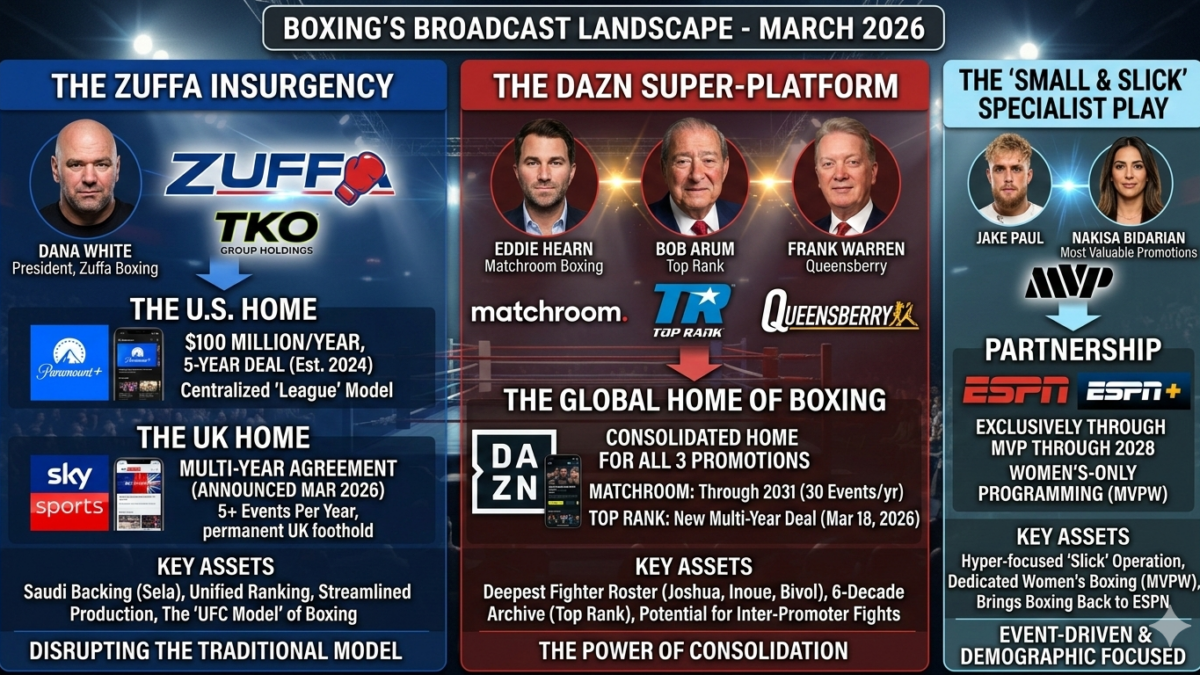
Matchroom Boxing locked in a five-year extension with DAZN through 2031, announced in February. Thirty events per year. Eddie Hearn isn’t going anywhere, and neither is the deepest roster in the sport — Anthony Joshua, Dmitry Bivol, Jesse Rodriguez, Jaron Ennis, Katie Taylor, Dalton Smith, and the rest.
Zuffa Boxing has its five-year deal with Paramount+ in the U.S., reportedly worth $100 million per year, and just announced a multi-year broadcast agreement with Sky Sports for the UK and Ireland — confirming Sky as the broadcaster for all Zuffa events with a commitment of at least five cards per year on British soil. Say what you want about Dana White’s entry into boxing, but that’s real money and real distribution on both sides of the Atlantic. Paramount+ also carries the UFC under a separate $7.7 billion deal, which means combat sports fans already have a reason to subscribe. Zuffa’s inaugural Paramount+ card launched in January, the promotion crowned its first champion when Jai Opetaia dominated Brandon Glanton on March 8, and it now has a UK broadcast home that gives it a permanent foothold in Europe’s biggest boxing market.
Top Rank and DAZN announced their multi-year deal today. Bob Arum’s entire roster — Xander Zayas, Keyshawn Davis, Abdullah Mason, Emanuel Navarrete, Raymond Muratalla, Bruce Carrington, the whole pipeline — now fights on the same platform as Matchroom and Queensberry. The six-decade archive comes with it. Dan Rafael has reported that Top Rank is also negotiating a second deal that could bring it back to ESPN, which would give Arum the multi-outlet model he’s been pushing for since before ESPN walked away.
PBC remains on Amazon Prime Video with five to six shows per year, mostly pay-per-view at $79.99 a pop. It’s not a volume play and it’s not cheap for fans, but Sebastian Fundora defending his WBC junior middleweight title against Keith Thurman on March 28 is a legitimate fight, and the PBC roster still has names that move the needle. The question with PBC has never been talent — it’s always been accessibility.
Most Valuable Promotions launched MVPW, its dedicated women’s boxing platform, and signed a multi-year deal with ESPN through 2028. Credit where it’s due — Jake Paul and Nakisa Bidarian saw a gap and filled it. More than 40 female fighters under contract. Caroline Dubois vs. Terri Harper on April 5 in London. Alycia Baumgardner vs. Bo Mi Re Shin at Madison Square Garden Theater on April 17. ESPN gets boxing back on its air, even if it’s women’s-only through MVP for now. These are real fights with real world titles on the line, not exhibitions.
That leaves Golden Boy. Oscar De La Hoya’s DAZN deal expired at the end of 2025, and as of right now, it hasn’t been formally renewed. Golden Boy did move forward with a one-off card on DAZN on March 14, headlined by Arnold Barboza Jr. vs. Kenneth Sims Jr. at the Honda Center, and De La Hoya has said publicly that he’s working on a new long-term extension. Golden Boy has fighters people want to see — Vergil Ortiz Jr., Oscar Collazo, Seniesa Estrada — and the sport is better when they have a stable home. But until pen hits paper, it’s the one obvious hole in the landscape.
What It Means
DAZN now houses Matchroom, Queensberry, Golden Boy (at least in practice), and Top Rank. That’s an extraordinary concentration of talent on one platform. The promise of that consolidation has always been simple: if everyone’s on the same network, the network politics that prevent the best from fighting the best should disappear. Matchroom fighters can face Top Rank fighters. Queensberry guys can face Golden Boy guys. The fights fans have been screaming for become logistically possible in a way they haven’t been in years.
Whether it actually plays out that way is a different question. Promoters are still promoters. They still have their own financial incentives, their own relationships, their own egos. Being on the same platform doesn’t automatically mean Vergil Ortiz vs. Jaron Ennis gets made tomorrow. But it removes one of the biggest structural barriers. That matters.
The other thing worth noting is that boxing now has real competition between platforms. DAZN dominates the traditional promotional model. Paramount+ and Sky Sports back the Zuffa insurgency on both sides of the Atlantic. Amazon carries PBC. Netflix swoops in for spectacle events. ESPN is back through MVP’s women’s series. That kind of competitive tension is healthy for the sport because it forces everyone to deliver better content, better production, and better fights.
It’s also worth noting that Saudi investment touches both sides of the divide. SURJ Sports, backed by the Saudi Public Investment Fund, holds a significant stake in DAZN. Sela, the Saudi entertainment conglomerate, is the co-venture partner funding Zuffa Boxing. Turki Alalshikh’s Riyadh Season cards air on DAZN while his connections run through the Zuffa structure as well. That’s not a criticism — it’s a reflection of how deeply Saudi capital is now embedded in the sport’s infrastructure. The growth is real. The investment has been transformative. But anyone paying attention to the business side of boxing should understand that the competitive landscape between platforms is more interconnected at the ownership level than it appears on the surface.
Six weeks ago, this sport looked like it was running out of places to put its product. Today, every major promotion except Golden Boy has a confirmed broadcast home, ESPN is back in the boxing business, and DAZN is closer to being a one-stop shop for the sport than any platform has been since the HBO-Showtime era. The landscape isn’t perfect. But for the first time in a while, it looks like a sport with an actual future.
If Golden Boy can get across the finish line with DAZN, the picture would be nearly complete.