By Larry Goldberg and Boxing Insider Staff
The Muhammad Ali American Boxing Revival Act passed the House on March 24, 2026. Most of the coverage has focused on UBOs, TKO, and the Senate path. The medical provisions have barely been discussed. They should be. They are the most significant and profound fighter safety changes in a generation, and they will affect every professional boxer in the country regardless of whether a single UBO is ever formed.
BoxingInsider.com has been critical of other provisions in this bill. The medical provisions are not one of them. If these standards are implemented as written, they will transform fighter safety in the United States. That should be applauded.
What the Bill Requires for All Professional Boxing
The bill amends the Professional Boxing Safety Act of 1996 to establish new medical standards that apply to every professional boxing match in the United States. These are not UBO-specific. They apply to every promoter, every fighter, every state.
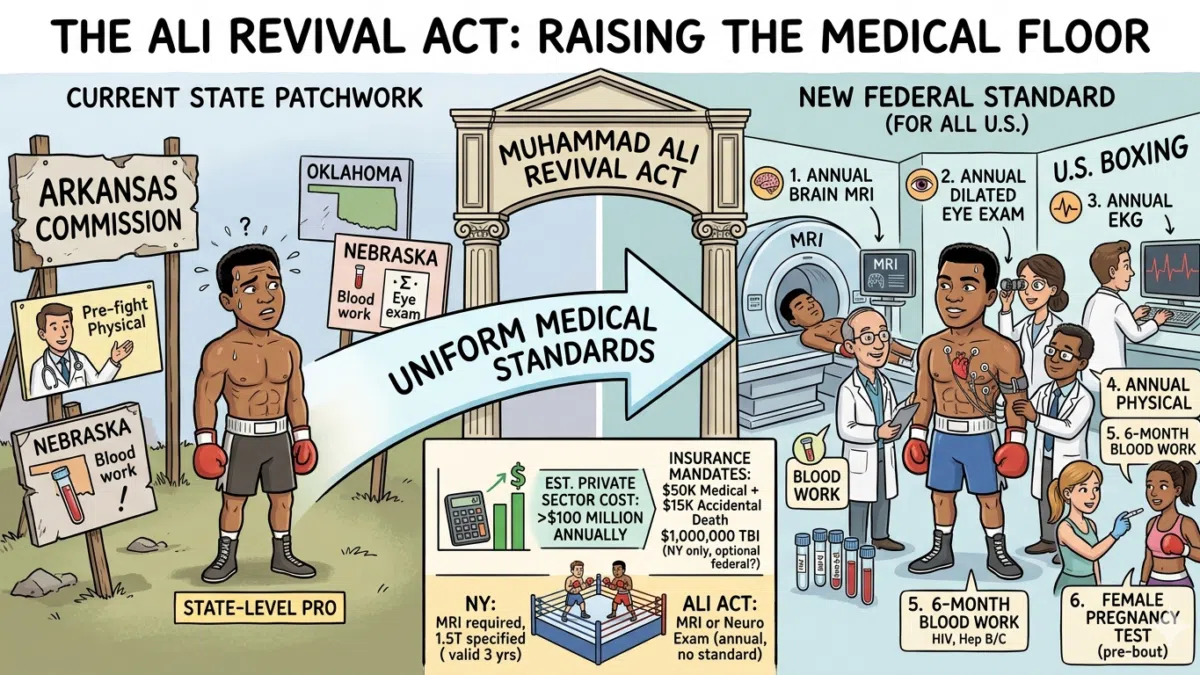
For fighters under 40, the bill requires all of the following: an annual brain MRI or neurological examination conducted by a neurologist, an annual dilated eye exam, an annual EKG, an annual comprehensive physical including blood work, and antibody testing for HIV, Hepatitis B surface antigen, and Hepatitis C antibody every six months. Female fighters must submit a pregnancy test within 14 days of a bout. Fighters 40 and over must meet all of the above plus an MRI and MRA of the brain and a cardiac stress test, all annually. (H. Rept. 119-524)
Consider the gap. Arkansas currently requires a pre-fight physical. That is it. No blood work, no brain imaging, no eye exam, no EKG. Oklahoma requires blood work and a physical. Nebraska requires a physical, blood work, and an eye exam.
They are not alone. According to the Association of Boxing Commissions’ own published data, approximately 28 to 30 states and jurisdictions currently have no brain imaging requirement whatsoever for professional boxers. Only about six or seven states, including New York, New Jersey, California, Nevada, Connecticut, and Rhode Island, require brain imaging for all professional fighters at baseline. The rest either require nothing or only trigger imaging for older fighters or on a case-by-case basis. The bill would change that overnight for every state in the country. That alone makes it the most significant fighter safety legislation Congress has ever passed.
These standards should not stop at boxing. Any combat sport where athletes are hit in the head should meet the same floor. The brain does not care what hit it.
There are genuine philosophical differences within the sport about UBOs and the separation between promoters and sanctioning bodies. This is not about that. On raising medical standards to what New York and New Jersey already require, nationwide, there should be no disagreement. That is where this outlet lines up 100 percent with what this bill is trying to do.
What New York and New Jersey Already Require
New York overhauled its standards after heavyweight Magomed Abdusalamov suffered a subdural hematoma following a 2013 fight at Madison Square Garden. Ringside doctors cleared him to leave in 18 minutes. He took a cab to the hospital, was in a coma for weeks, and remains paralyzed. New York paid his family $22 million and rebuilt its medical protocols from the ground up.
Today every fighter licensed in New York must complete the following before they are cleared to compete (NYSAC Medical Standards): brain MRI on a minimum 1.5 Tesla magnet with five specific imaging sequences (valid 3 years, results reviewed by the Chief Medical Officer before clearance), dilated eye exam, EKG, blood work, and a pre-fight physical conducted by NYSAC panel physicians at weigh-in. Neurological evaluation is not an annual requirement. It is triggered when a fighter is coming off a knockout or at the commission’s discretion. A fighter with a bad KO will be required to obtain neurological clearance before competing again. $50,000 general medical coverage and $1,000,000 traumatic brain injury coverage per fighter.
New Jersey requires a CT or MRI of the brain as a condition of licensure, a dilated eye exam, an EKG, blood work, and a physical. All testing other than the brain scan is valid for six months. Fighters over 40 need an MRI, MRA, and cardiac testing. New Jersey does not require a neurological exam at baseline. After a knockout, the commission evaluates on a case-by-case basis whether neurological clearance is needed before a fighter can compete again. At a recent Boxing Insider Promotions show in Atlantic City, a fighter who was stopped was required by NJSACB to obtain neurological clearance. That is the system working.
What It Actually Costs
After pricing out many options, Boxing Insider Promotions found a full medical compliance package in New Jersey for $865 per fighter: CT head scan ($325), physical and EKG ($250), dilated eye exam ($140), blood panel ($95), coordination fee ($55). Two days. Brain imaging valid for three years unless there is a traumatic event. All other testing valid for six months.
Prices vary widely. Published pricing from another combative sports medicine facility shows a CT brain at $700, a physical at $212, an eye exam at $187, a blood trio (Hep B, Hep C, HIV) at $300, and an EKG at $125. The same CT-based compliance package through individual providers totals approximately $1,525. The MRI route is steeper: $1,187 for the brain MRI alone, bringing a full MRI-based package to over $2,000.
But $865 is just the medical line item. In practice, for an out-of-town fighter with no current medicals, a promoter is also paying for the fighter to fly in one to two days early, a driver to pick them up from the airport, a hotel room, and transportation to and from the testing facilities. All medical forms must be completed by a U.S. hospital and licensed U.S. physicians, so foreign fighters cannot get this done in advance. The New Jersey commission requires medicals to be submitted and approved 48 hours before weigh-ins. With out-of-town and international fighters, a promoter may not have clearance, or a failure, until the last minute. That is one reason fights fall off cards at the last minute that fans and media never understand. The $865 is real. The logistics around it can double or triple the actual cost to the promoter.
There is another reality that rarely gets discussed publicly. Some fighters who fail a medical test in one state never submit the results. Because the fighter was never licensed in that state, the failed test never enters the system. The fighter goes to a jurisdiction with lower standards and gets cleared there. It is called commission shopping and it happens. HIPAA laws complicate the sharing of medical information between states, which means a failed eye exam in New Jersey does not automatically follow a fighter to a state that does not require one. The system is not perfect. But the states that have real standards catch problems that other states never look for. That is the argument for a federal floor. Not to punish the states that are doing it right, but to close the gap that lets fighters slip through.
The Congressional Budget Office scored the entire bill at less than $500,000 in federal costs over ten years. Private sector mandates exceed $100 million annually nationwide, driven by medical testing, insurance, drug testing, and minimum pay requirements.
Insurance varies significantly by state. A typical club card in New Jersey carries $50,000 in accidental death and $20,000 in maximum medical benefit per fighter with a $500 deductible. In New York, the same card requires $50,000 in accidental death, $50,000 in medical per fighter, and $1,000,000 in traumatic brain injury coverage per fighter. In other states, minimums are lower or nonexistent. The bill raises the medical coverage floor to $50,000 per fighter and adds $15,000 in accidental death coverage nationally. BoxingInsider.com will publish a detailed breakdown of insurance premiums by state in a future article.
These provisions will save lives. They will also push some smaller shows in states with weak commissions out of business. The medical testing is one line item. Before the first bell, a promoter has paid for fighter medicals, insurance, plane tickets, hotel rooms, meals, venue costs, commission fees, and equipment. Most club shows run on ticket-selling fighters to cover the costs. The margins are razor thin. Adding $865 per fighter in medical compliance and increased insurance premiums to a six-bout card is real money. Some promoters will not be able to absorb it. That is a real consequence. It is also the cost of regulating a sport where the goal is to punch someone in the head. New York and New Jersey still have active club boxing. But it is hard. It has always been hard. And anyone who tells you otherwise has never written the checks.
Where the Senate Can Go Further
The bill allows fighters under 40 to choose between an MRI or a neurological exam. That means a fighter can skip the brain scan entirely and satisfy the requirement with a neuro exam alone. New York requires the MRI. There is no option to substitute it with a neuro exam. The Senate should consider removing the “or” and requiring the MRI for all fighters.
The bill says “MRI” without defining magnet strength or imaging sequences. New York specifies a 1.5 Tesla minimum with five required sequences. Without a standard, compliance can vary widely while technically satisfying the law. Many discount imaging centers use 0.3T or 0.6T open MRIs that lack the resolution to detect the micro-hemorrhages and axonal injuries common in combat sports. An MRI without a Tesla standard is a checkbox, not a diagnostic tool.
The bill does not establish a federal concussion protocol. The NFL, NHL, and youth soccer all have one. Boxing does not.
Interstate medical suspensions are already required by the original Ali Act. They have been ignored. The bill does not add enforcement.
Baseline neurological testing is not required. Without a baseline, post-fight evaluations have no point of comparison.
Side by Side
| Requirement | Ali Revival Act | New York | Tennessee | Florida |
|---|---|---|---|---|
| Brain Imaging | MRI or Neuro (annual) | MRI (3 yrs, 1.5T min) | None | None (40+ only) |
| MRI Standard | Not specified | 1.5T, 5 sequences | N/A | N/A |
| Fighters 40+ | MRI + MRA + Stress | Case-by-case | No additional | MRI + EKG + Physical |
| Post-KO Clearance | Not specified | Commission discretion | Not specified | Not specified |
| Neuro Exam | Annual (or MRI) | Post-KO only | 35+ only (2 yrs) | Not required |
| Antibody Testing | Every 6 months | Annual | Every 6 months | Annual |
| Eye Exam | Annual (dilated) | Dilated (ophthalmologist) | Dilated (2 yrs) | Annual (dilated) |
| EKG | Annual | Annual | Not required | 40+ only |
| Physical | Annual | At weigh-in (NYSAC) | Pre-licensing (2 yrs) | Pre-fight only |
| Medical Coverage | $50,000 | $50,000 | Not specified | $20,000 |
| TBI Coverage | Not required | $1,000,000 | Not required | Not required |
| Accidental Death | $15,000 | $50,000 | Not specified | $20,000 |
Sources: H.R. 4624 bill text, H. Rept. 119-524, NYSAC Medical Standards Manual, ABC Medical Requirements by Commission, Florida Athletic Commission FAQs, CBO Score
The Bottom Line
It should be noted that these medical provisions were not in the original bill introduced in July 2025. Supporters of the legislation have said the bill did not change the Professional Boxing Safety Act. It did. Whoever added these requirements did a very good deed. They will save more lives than anyone will ever know. Without getting in trouble, I would like to buy that person a steak dinner. Hopefully someone will.
There is a harder truth here. There are fighters, guys people like, guys with names, who will fail these standards. Some will be forced to go overseas to jurisdictions that do not require them. That is not a flaw in the system. That is the system working. An MRI that catches something before it becomes permanent is not an obstacle. It is the difference between a fighter who retires on his own terms and one who cannot remember why he stopped.
If Senator Cruz’s Commerce Committee wants to take this seriously, the model already exists. Six states are already the adults in the room. New York, New Jersey, California, Nevada, Connecticut, and Rhode Island already require brain imaging for every professional fighter. Their forms, their protocols, and their results are public record. The federal baseline should start there.
BoxingInsider.com will publish a detailed comparison of the state medical forms and the new federal requirements in a future article.
The question nobody has answered yet: who enforces this? The bill does not add or clarify enforcement. That deserves its own article.
This bill will save lives. But please keep the firewall.