Floyd Mayweather Jr. spent a 21-year professional career making sure nobody could beat him. Now, nearly nine years after his final professional fight, the 50-0 Hall of Famer is waging a different kind of battle, one that alleges the people closest to him during boxing’s most lucrative era helped steal a staggering portion of his fortune.
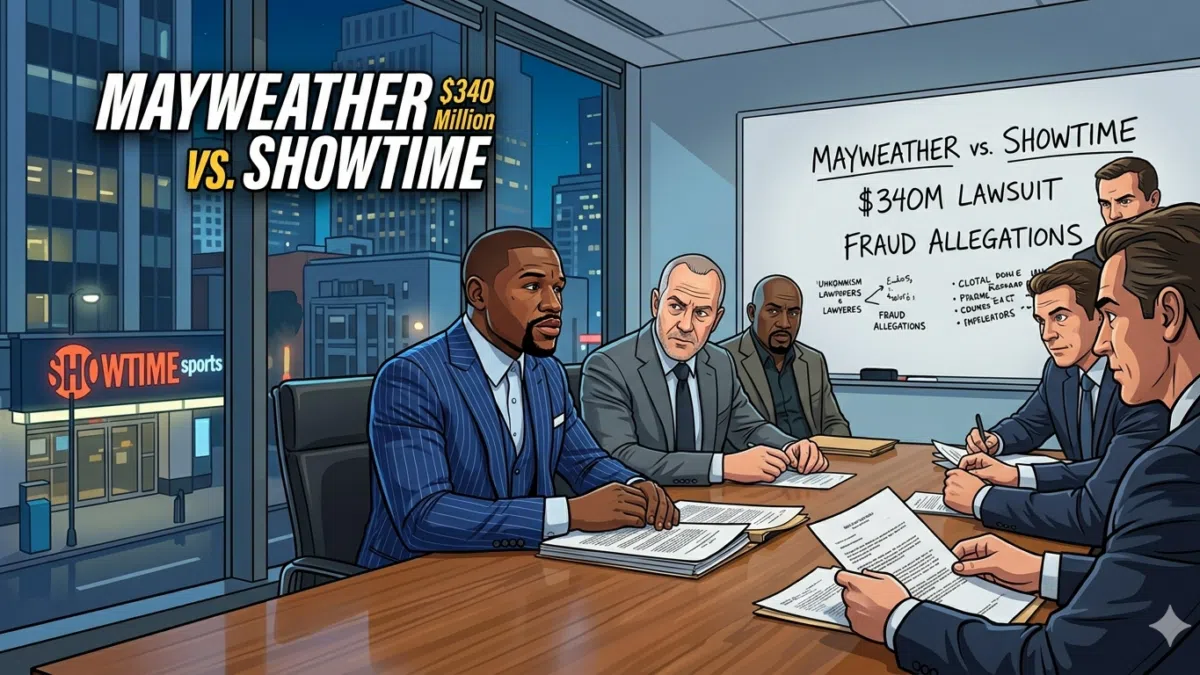
The 25-page complaint filed in Los Angeles County Superior Court on February 4, 2026 (some reports cite February 3) names Showtime Networks Inc. and former Showtime Sports president Stephen Espinoza as defendants. Mayweather is seeking at least $340 million in compensatory damages, plus punitive damages, alleging that Showtime and Espinoza knowingly participated in what the filing describes as an elaborate, years-long scheme of financial fraud orchestrated by his former manager and advisor, Al Haymon.
Haymon, notably, is not named as a defendant.
The Showtime Era: Boxing’s Richest Partnership
To understand the magnitude of the allegations, it helps to revisit how the Mayweather-Showtime partnership came together in the first place.
In 2013, Mayweather left HBO, his longtime broadcast home, to sign a 30-month, six-fight deal with Showtime. As ESPN reported, it was at the time the richest contract for an individual athlete in sports history. The deal was driven in large part by Espinoza, who had joined Showtime from the entertainment law firm Ziffren Brittenham and pushed aggressively to land Mayweather as the centerpiece of the network’s boxing strategy.
The results were historic. Mayweather fought eight times on Showtime pay-per-view, facing Robert Guerrero, Canelo Alvarez, Marcos Maidana twice, Manny Pacquiao, Andre Berto, and Conor McGregor. The Pacquiao bout in May 2015 remains the highest-grossing pay-per-view event in boxing history, generating over $410 million in PPV revenue on an estimated 4.4 million buys. The McGregor fight in August 2017 ranks second all-time. Mayweather’s reported career earnings topped $1.2 billion.
Throughout this run, Mayweather publicly praised the trio of Haymon, Espinoza, and Showtime. Before and after his biggest fights, he would thank all three by name. In 2014, he called Haymon “a great guy, a tremendous guy” and “a man of his word.”
What the Lawsuit Alleges
The complaint paints a starkly different picture than the public relationship suggested. According to the filing, Haymon first began managing Mayweather’s career around 2004 under a verbal agreement that entitled Haymon to a 10 percent fee. That agreement technically expired after a year, but Haymon continued in the role for roughly two decades, handling contract negotiations, television deals, sponsorships, and investments.
The lawsuit alleges that instead of routing fight revenues directly to Mayweather, Showtime wired earnings to accounts controlled by Haymon and associates, including an account linked to Mayweather’s tax attorney Jeff Morris. From there, according to the complaint, funds were diverted through what Mayweather describes as a web of hidden accounts, unauthorized transactions, and falsely labeled transfers. Banking records cited in the suit allegedly show large transfers to an entity called Alan Haymon Development shortly after major fights, labeled as “reimbursements” or “loan payoffs” that Mayweather says were not legitimate.
One of the more specific allegations involves the Pacquiao fight. The complaint claims that financial documents show inflated expense reimbursements charged against the Pacquiao revenue pool, including a $20 million payout for the September 2015 Berto bout that was drawn from Pacquiao fight proceeds. Mayweather alleges that the Pacquiao revenue was used as a slush fund for unrelated costs. These are serious claims, and they remain unproven.
The suit also alleges that contract dates were physically altered, with the complaint referencing a notation on one document that read, in essence, “we need to cover ourselves.”
The Records Question
Perhaps the most striking allegation involves what happened when Mayweather’s new management team tried to get answers. In mid-2024, after installing Richard Schaefer as CEO of Mayweather Promotions to replace longtime lieutenant Leonard Ellerbe, Mayweather’s team requested detailed financial breakdowns from Showtime for some of his biggest fights, including the Pacquiao and McGregor bouts.
According to the complaint, the response was that critical financial records had been “lost in a flood” at a storage facility or were otherwise “stored off-site and not readily accessible.” Showtime separately asserted a statute of limitations defense, arguing that any claims related to fights in 2015 were time-barred.
For Mayweather’s legal team, led by attorney Bobby Samini, the inaccessibility of records and the limitations argument amount to ongoing concealment that should toll the statute of limitations. Whether a court agrees will likely be one of the central legal questions in the case.
The Causes of Action
The complaint outlines four causes of action against Showtime and Espinoza: aiding and abetting breach of fiduciary duty, civil conspiracy to commit fraud, conversion, and unjust enrichment. The filing argues that Showtime and Espinoza knew Haymon was Mayweather’s fiduciary, recognized that payments far exceeding Haymon’s 10 percent fee were being routed through irregular channels, and did nothing to intervene or alert Mayweather.
The complaint further alleges that Espinoza’s post-Showtime career trajectory supports its theory. After Showtime Sports shut down at the end of 2023, Espinoza took a consulting role with Haymon’s Premier Boxing Champions. The lawsuit frames this as evidence of an ongoing alignment between the two.
Espinoza Responds
On February 7, Espinoza broke his silence in an interview on the YouTube podcast Compas On The Beat, reported by journalist Manouk Akopyan. While careful not to address legal specifics, Espinoza pushed back firmly, telling interviewers that he had not yet seen the formal paperwork and that his attorneys had counseled restraint.
As BoxingInsider reported at the time of the filing, Espinoza expressed both surprise and disappointment. He told the podcast he was proud of his reputation for integrity and that he had never acted to shortchange a fighter. He went further, calling the suit “a mystery in a lot of ways” and adding that he had not spoken to Mayweather about it directly. “The lawsuit will take care of itself,” he said.
A spokesperson for Paramount, Showtime’s parent company, called the claims baseless and lacking in factual merit, pledging to respond through the court process. Haymon, who rarely speaks publicly, did not comment.
The Haymon Question
The absence of Haymon as a named defendant is the most conspicuous element of the lawsuit. The complaint describes him as the architect of the alleged fraud scheme, yet targets only the network and the executive who facilitated the payments. Multiple reports have indicated that a separate lawsuit against Haymon may follow, though none has materialized as of this writing.
In his reporting on the lawsuit, veteran boxing journalist Dan Rafael noted that an individual familiar with the case said a second lawsuit against Haymon was expected. The decision to sue Showtime first may be a strategic choice, whether to access financial records through discovery, to establish the framework of the fraud allegations, or for reasons related to the personal relationship between Mayweather and Haymon. The complaint itself acknowledges that Mayweather once considered Haymon a “father figure” who managed virtually every aspect of his finances.
The Bigger Picture for Boxing
Regardless of how the case is resolved, the Mayweather-Showtime lawsuit exposes a structural vulnerability in boxing’s financial model that the sport has never adequately addressed. Unlike team sports with centralized league offices, salary caps, and transparent revenue sharing, boxing’s economic ecosystem relies on a patchwork of bilateral deals between fighters, managers, promoters, and broadcasters. Payment flows are opaque by design. Fighters, even those at the very top of the sport, routinely depend on their advisors to navigate financial arrangements they do not fully understand.
The irony is not lost on longtime observers. Mayweather was boxing’s most powerful independent operator, a fighter who controlled his own promotion, chose his own opponents, and dictated terms to networks. If these allegations have any merit, they suggest that even the sport’s most empowered athlete could be vulnerable to the kind of financial mismanagement that has plagued boxing for generations.
One of the central questions the case raises is whether a broadcaster like Showtime has a duty to ensure fight revenues reach the intended recipient, or whether it can simply follow payment instructions from a fighter’s designated representatives. The answer could reshape how future contracts between fighters, networks, and managers are structured.
The case is in its early stages. No trial date has been set, and Showtime has yet to file a formal response. But the complaint is now part of the public record, and the questions it raises about trust, transparency, and the business of boxing’s biggest fights will follow the sport regardless of the outcome.