In boxing, few things cause more problems than a southpaw. The angles are wrong. The jab comes from the opposite side. The power hand is where it shouldn’t be. For most of boxing’s history, southpaws were avoided — trainers didn’t want the headache, promoters didn’t want the risk, and orthodox fighters didn’t want to spend a training camp learning how to fight backwards.
The fighters on this list didn’t just survive in a sport that didn’t want them. They dominated it.
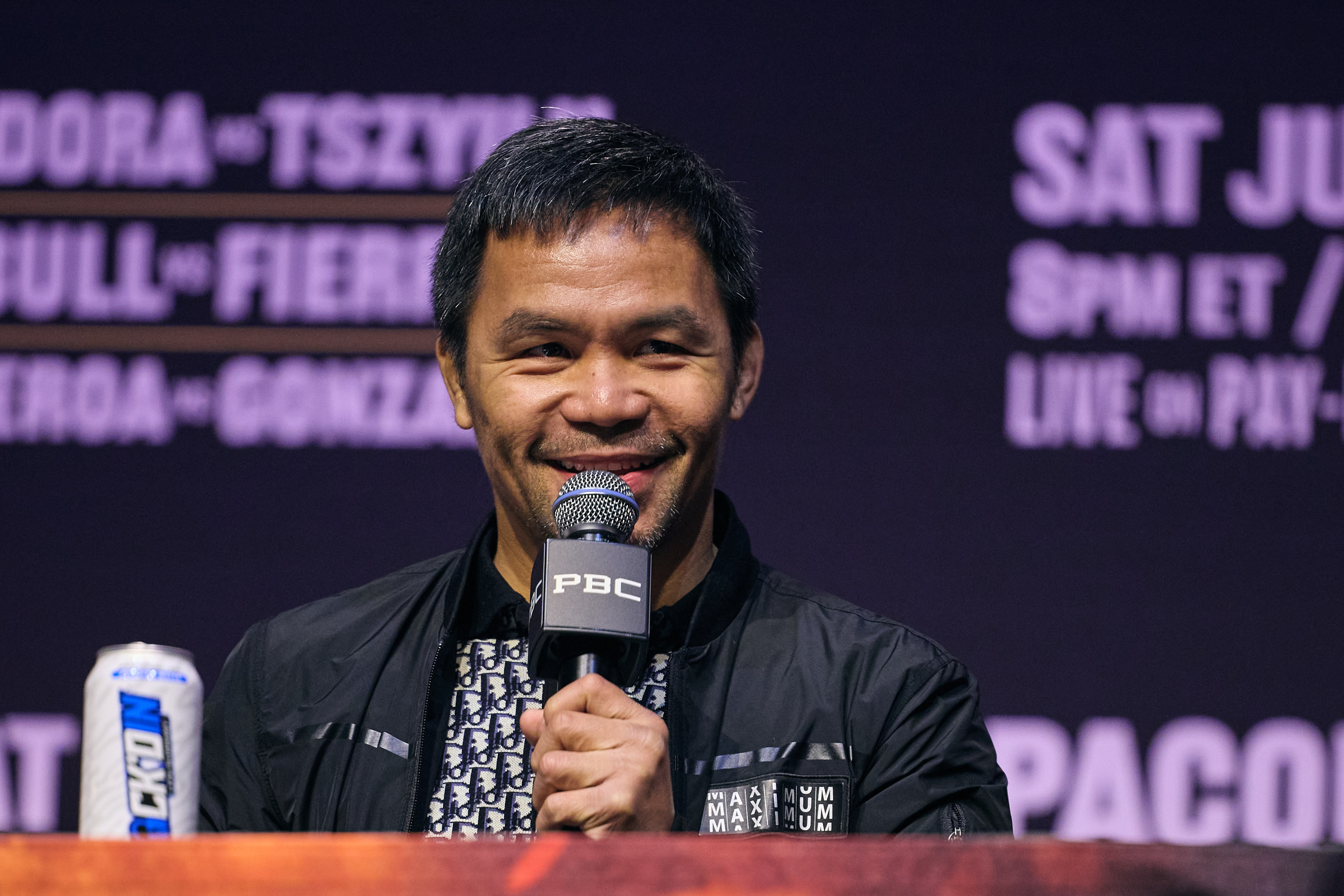
1. Manny Pacquiao
Record: 62-8-2 | KOs: 39 | Titles: Eight-division world champion
No southpaw in history compiled a resume like Pacquiao’s. Eight-division world champion. Titles across four decades. Victories over Oscar De La Hoya, Ricky Hatton, Miguel Cotto, Marco Antonio Barrera, Erik Morales, and Antonio Margarito — fighters who ranged from 112 to 154 pounds. His leaping left cross, thrown from angles that orthodox fighters couldn’t anticipate, was the defining offensive weapon of his era.
Freddie Roach turned Pacquiao’s raw aggression into calculated destruction, and the combination produced one of the most entertaining fighters who ever lived. He fought anyone, at any weight, and won more often than he had any right to. His career is fully documented on BoxRec.
2. Marvelous Marvin Hagler
Record: 62-3-2 | KOs: 52 | Titles: Undisputed middleweight champion (1980-1987)
Hagler was right-handed but fought southpaw — a strategic decision that put his power hand closer to his opponents and created angles they couldn’t solve. He held the undisputed middleweight title for nearly seven years, making 12 successful defenses against world-class opposition including Roberto Duran, Thomas Hearns, and John Mugabi.
His three-round war with Hearns in 1985 remains one of the most violent and thrilling fights in boxing history. Hagler’s ability to switch stances mid-fight made him almost impossible to prepare for. As The Ring documented, he was named Fighter of the Decade for the 1980s — the highest recognition of sustained dominance the sport offers.
3. Pernell Whitaker
Record: 40-4-1 | KOs: 17 | Titles: Four-division world champion, 1984 Olympic gold medalist
“Sweet Pea” was the greatest defensive fighter of his generation and arguably of all time. His head movement, footwork, and ability to make world-class fighters miss by inches — repeatedly — turned boxing into a one-sided game of keep-away. His controversial draw against Julio Cesar Chavez in 1993 is widely regarded as a robbery; most observers had Whitaker winning clearly.
Whitaker didn’t rely on power. He controlled fights through rhythm disruption, counter-punching, and positioning so precise that opponents looked like they were fighting a ghost. He held the longest unified lightweight title reign in history and dominated at 135, 140, 147, and 154 pounds. His career is on BoxRec.
4. Terence Crawford
Record: 41-0 | KOs: 31 | Titles: Undisputed welterweight champion, three-division titlist
Crawford is the best active southpaw in boxing and one of the most complete fighters of the modern era. His undisputed welterweight title win over Errol Spence Jr. — stopping a previously unbeaten opponent who many considered his equal — was the defining performance of 2023. His ability to switch stances fluidly, adjust mid-fight, and find finishing angles makes him a nightmare for any style.
Crawford’s resume continues to grow, with his fight against Canelo Alvarez representing the kind of cross-divisional showdown that cements legacies. He’s tracked on BoxRec and covered extensively by ESPN.
5. Oleksandr Usyk
Record: 22-1 | KOs: 14 | Titles: Undisputed heavyweight champion, former undisputed cruiserweight champion
Usyk is the only fighter in history to hold undisputed titles at both cruiserweight and heavyweight. His southpaw style — built on footwork, angles, and a jab that controls range — systematically dismantled Anthony Joshua twice and Tyson Fury in their first meeting. At 6’3″ and around 220 pounds, he’s undersized for the heavyweight division, but his technical mastery compensates for what he lacks in raw size.
Add an Olympic gold medal from 2012, and Usyk has arguably the most complete amateur-to-professional résumé of any active fighter. As reported by BBC Sport, his place among the all-time great heavyweights is already secured.
6. Joe Calzaghe
Record: 46-0 | KOs: 32 | Titles: WBO super middleweight champion (10-year reign), WBA light heavyweight champion
Calzaghe retired undefeated after 46 fights, holding the super middleweight title for a decade — the longest reign in the division’s history. His hand speed, work rate (often exceeding 100 punches per round), and relentless volume overwhelmed opponents who expected to outbox him. His wins over Mikkel Kessler, Jeff Lacy, and a 43-year-old Bernard Hopkins capped a career of sustained excellence.
Calzaghe never received the American recognition he deserved, largely because he spent most of his career fighting in Wales. But 46-0 speaks for itself. His record is on BoxRec.
7. Michael Moorer
Record: 52-4-1 | KOs: 40 | Titles: WBO light heavyweight champion, WBA/IBF heavyweight champion
Michael Moorer made history in 1994 when he outpointed Evander Holyfield to become the first southpaw heavyweight champion in boxing history. The significance of that achievement is easy to overlook now, but for decades, conventional wisdom held that a left-handed fighter couldn’t succeed at heavyweight. Moorer proved that wrong — until George Foreman’s legendary 10th-round knockout reset the narrative.
Before moving to heavyweight, Moorer was a destructive light heavyweight, winning the WBO title and defending it successfully. His career is on BoxRec.
8. Vasiliy Lomachenko
Record: 18-3 | KOs: 12 | Titles: Three-division world champion, two-time Olympic gold medalist
Lomachenko’s amateur pedigree — 396 wins and only one loss, plus gold medals at the 2008 and 2012 Olympics — is among the greatest in boxing history. As a professional southpaw, his footwork, angle creation, and ability to pivot around opponents mid-exchange redefined what technical boxing looks like at the lighter weights. He won world titles in three divisions within his first 12 professional fights, a record pace.
His style has been studied by coaches worldwide as a masterclass in southpaw movement. ESPN ranked him among the top pound-for-pound fighters of the 2010s.
9. Hector Camacho
Record: 79-6-3 | KOs: 38 | Titles: WBC super featherweight, lightweight, and junior welterweight champion
“Macho” Camacho was equal parts showman and fighter. His hand speed from the southpaw stance was blinding, and his footwork allowed him to fight at range or in the pocket depending on what the moment required. He won titles in three weight classes and fought a who’s-who of 1980s and ’90s competition, including Sugar Ray Leonard, Julio Cesar Chavez, Felix Trinidad, and Oscar De La Hoya.
Camacho’s flamboyance sometimes overshadowed his skill, but make no mistake — he was a genuinely elite southpaw. His record is on BoxRec.
10. Vicente Saldivar
Record: 37-3 | KOs: 26 | Titles: WBC/WBA featherweight champion
Mexico’s greatest southpaw, Saldivar held the featherweight title from 1964 to 1967, making seven successful defenses before retiring unbeaten. His rivalry with Howard Winstone — three fights, all won by Saldivar — is one of the great featherweight series in history. He came out of retirement to beat Johnny Famechon for the WBC title in 1970 before losing to Eder Jofre.
Saldivar’s combination of body work, relentless pressure, and left-hand power made him nearly unbeatable at 126 pounds. He was inducted into the International Boxing Hall of Fame in 1999.
Honorable Mentions
Tiger Flowers — The first Black middleweight champion (1926), with 118 career wins. Young Corbett III — 124 victories including wins over five Hall of Famers. Antonio Tarver — His second-round knockout of Roy Jones Jr. is one of the great single-punch finishes in history. Zab Judah — Elite hand speed from the southpaw stance, undisputed welterweight champion. Sergio Martinez — Argentina’s finest, middleweight champion whose left hand was a genuine concussive weapon.