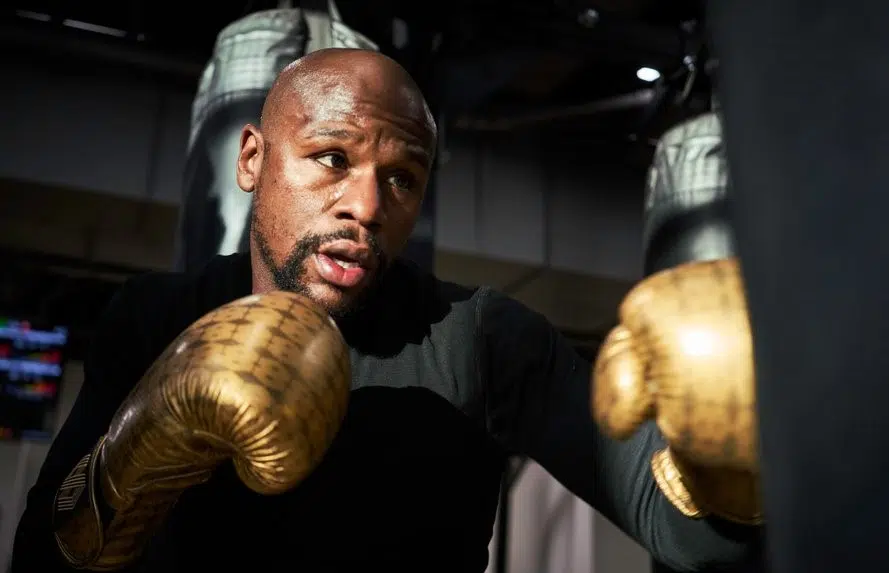
Ten years ago, Floyd Mayweather Jr. sat down on ESPN and did what he’s always done best besides slipping punches — he made himself the center of the conversation. Asked to select the five greatest boxers of all time from a list of ten legends displayed on screen, Mayweather put himself at the top and Muhammad Ali at the bottom.
The list, in full:
- Floyd Mayweather
- Roberto Duran
- Pernell Whitaker
- Julio Cesar Chavez
- Muhammad Ali
It was audacious. It was calculated. And whether you agree with it or not, each pick tells you something about how Mayweather views the sport — and how he views himself within it.
No. 1: Floyd Mayweather
Mayweather did not hesitate. He picked himself first and built the argument on numbers, not nostalgia.
“He’s beaten more world champions than any other fighter here,” Mayweather said, referring to himself in the third person. “He’s done it in a shorter period of time than any other fighter up here and he’s done it with less fights. Record-breaking numbers all around the board. Pay-per-view, live gate, landed punches on a higher percentage and took less punishment.”
By 2015, he had already defeated Oscar De La Hoya, Shane Mosley, Miguel Cotto, Canelo Alvarez, and Manny Pacquiao in the richest fight in boxing history. He would retire two years later at 50-0. The criteria — longevity, accuracy, financial dominance, damage avoidance — were the pillars of his entire career philosophy.
The self-appointment drew predictable backlash. Mike Tyson, speaking to the Undisputed Champion Network, was blunt: “He’s very delusional. If he was anywhere near that realm of great as Muhammad Ali, he’d be able to take his kids to school by himself.” Ali himself responded with a tweet days later that read simply: “Don’t you forget, I am the greatest!”
No. 2: Roberto Duran
This was the most respected pick on the list. The Panamanian known as “Hands of Stone” won his first world title at lightweight in 1972 and his last at middleweight in 1989. In between, he went to war with Sugar Ray Leonard, Thomas Hearns, Marvin Hagler, and Iran Barkley — the heart of boxing’s golden era.
Mayweather’s description was succinct: “Unbelievable.” Duran finished 103-16 with 70 knockouts across a 33-year professional career. His 1980 victory over Leonard in Montreal remains one of the defining performances in welterweight history. That the “No Mas” rematch is often cited against him only reinforces how high the bar was set — Duran came back, moved up in weight, and won two more world championships.
No. 3: Pernell Whitaker
If the Duran pick was about toughness across eras, the Whitaker selection was personal. “Sweet Pea” was the closest thing to a spiritual predecessor for Mayweather’s own style — a defensive virtuoso who made elite fighters miss and made it look effortless.
Whitaker’s signature performance came in 1993 against Julio Cesar Chavez, then 87-0 and considered untouchable. Whitaker boxed circles around him for 12 rounds. The judges returned a majority draw. Most observers — Mayweather among them — believed Whitaker won clearly.
“He knew how to win,” Mayweather said. “He beat Chavez for real, and I’m a Julio Cesar Chavez fan even though he beat my uncle, Roger Mayweather, twice.”
Whitaker finished 40-4-1, but his prime-years run from 1988 through the mid-1990s was as dominant as any lighter-weight fighter has ever produced. His tragic death in a 2019 hit-and-run in Virginia Beach only deepened the sense that Sweet Pea never received the recognition his skills deserved.
No. 4: Julio Cesar Chavez
Chavez at No. 4 was both a crowd-pleaser and a defensible boxing pick. The pride of Culiacan, Sinaloa began his career 87-0 before the Whitaker draw — the longest unbeaten streak to start a career in modern boxing history. He won world titles at super featherweight, lightweight, and junior welterweight through relentless pressure, an iron chin, and body work that broke fighters down round by round.
His final record of 107-6-2 with 86 knockouts places him among the most prolific winners in boxing history. In Mexico, he transcended the sport entirely — Chavez fights in the early 1990s shut down entire cities.
The personal connection mattered. Roger Mayweather lost to Chavez twice. Floyd grew up watching those fights. Ranking Chavez at No. 4 while giving Whitaker credit for outboxing him was a characteristically Mayweather move: cold analysis over sentiment, even when family was involved.
No. 5: Muhammad Ali
This is where the list generated the most heat. Ali at No. 5 struck many as borderline disrespectful to the most famous athlete in boxing history.
Mayweather’s reasoning was blunt: “Ali really lost all three times to Ken Norton. This is me just being honest.” He also noted Ali competed in only one weight class while the other four fighters on his list all won titles in multiple divisions. As the Washington Post observed at the time, this criticism was somewhat unfair — expecting a natural heavyweight to move down in weight is unreasonable.
But Mayweather gave Ali something the others didn’t receive: cultural credit. “What Ali did was he stood for a cause in an era where African Americans didn’t stand up for their people and he stood up for a strong cause.” It was an acknowledgment that Ali’s greatness extended beyond the ring — and perhaps an admission that Mayweather’s own framework, built on statistics and ring performance, couldn’t fully capture what Ali meant to the sport.
The List That Evolved
Mayweather didn’t stick with these rankings. Five years later, during a 2020 Instagram Live conversation with rapper Fat Joe, he revised his top five. He kept himself at No. 1 and kept Whitaker and Duran, but dropped both Chavez and Ali entirely:
- Floyd Mayweather
- Pernell Whitaker
- Roberto Duran
- Larry Holmes
- Aaron Pryor
The Holmes pick drew the loudest reaction. Fat Joe pushed back hard, insisting Ali belonged. Mayweather was unmoved, citing Holmes’ fundamentals, his 20 consecutive heavyweight title defenses, and — in a detail that says everything about Mayweather’s worldview — his post-career financial success. “He had the basic fundamentals, he had the jab, and even right now he’s still living a great life because he made smart investments.”
Pryor was a deep cut that impressed boxing historians. “The Hawk” went 39-1 with 35 knockouts and fought two legendary bouts against Alexis Arguello. Mayweather acknowledged that Pryor’s only real blemish was substance abuse outside the ring, not anything an opponent did inside it.
Taken together, the two lists reveal a fighter who evaluates greatness through a specific lens: defensive mastery, multi-division success, longevity, and physical preservation. It is the ranking system of a man who went 50 fights without a loss and retired with his speech clear, his motor skills intact, and roughly a billion dollars earned. Mayweather’s list was never about settling the all-time debate — it was about defining greatness on his own terms, which is exactly what he did for his entire career.