
By Larry Goldberg and Boxing Insider Staff
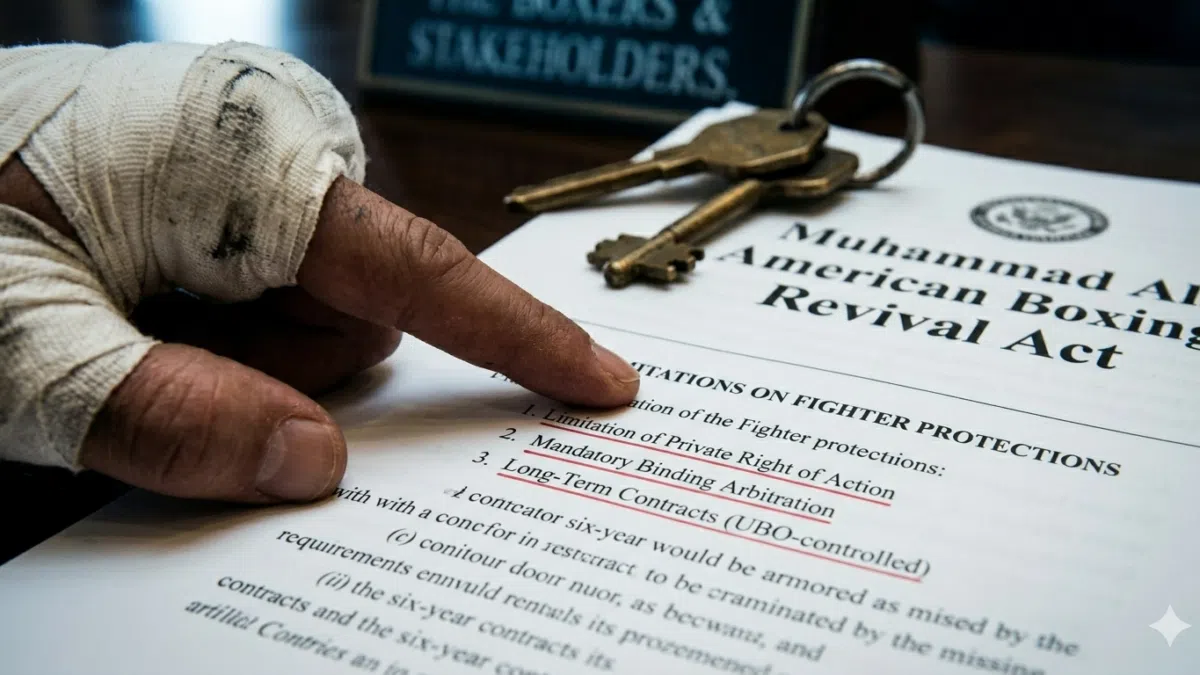
Imagine a day in the not so distant future. The new Ali bill has passed Congress and been signed by the President. The Muhammad Ali American Boxing Revival Act is federal law. The President held the ceremony. The press releases went out. Dana White posted a video. Congress celebrated the first update to federal boxing law in 26 years. Certain boxing people are crying inconsolably that their way of life is over, and they may not be wrong. The bill creates a Unified Boxing Organization structure that allows a single entity to promote fights, rank fighters, award titles, and control contracts with no independent check on that power.
Now what? Who is looking out for you? You are a club fighter or the next prospect. What does the morning after actually look like?
Every professional boxing match in America is now subject to new federal requirements. Annual brain MRIs or neurological examinations. Dilated eye exams. EKGs. Comprehensive blood panels. Antibody testing. ABC-certified ringside physicians. ABC-certified judges and referees. A $200/round minimum for every professional boxer in the country. Better insurance coverage when they fight. And fighters should have every one of those things. As BoxingInsider.com’s breakdown of the medical provisions detailed, these are genuine, overdue upgrades that will save lives if they are actually implemented.
The question is: how?
How Do 50 States Implement This?
The federal government cannot order a state athletic commission to do anything. The Tenth Amendment prevents Congress from commandeering state agencies. The Ali Act regulates promoters and events, not commissions. H.R. 4624 does the same.
In New York and New Jersey, the transition is almost seamless. These commissions already require brain imaging, comprehensive blood work, and dilated eye exams. The new federal floor is close to the ceiling they already operate under.
In Alabama, where the current requirement is a pre-fight physical and nothing else, the morning after is a different story. A fighter getting punched in the head in Mobile has the same brain as a fighter getting punched in the head in Manhattan, but only one of them has been getting an MRI. The bill says both of them should. But the bill also says “brain MRI or neurological examination.” That single word, “or,” means a fighter in a state with a weak commission can sit in a chair, have a doctor check his reflexes and follow a finger with his eyes, and check the federal box. Alabama will take the “or.” The bill claims to be a national standard. The word “or” guarantees it is not.
This is not a radical position: every fighter competing professionally in the United States, in boxing, MMA, kickboxing, or any combat sport that involves getting hit in the head, should have a brain MRI or CT scan at least once every three years as a condition of being licensed to compete. Additional imaging should be required after any traumatic event in the ring. A neurological exam is a useful tool as part of the overall physical, but it cannot replace imaging. And CT scans are not expensive or hard to find. Change “or” to “and” and you have a real national standard. Leave it as “or” and you have a loophole that swallows the entire provision.
And who pays for the exams? The bill mandates the MRI, the blood work, the eye exam, the EKG. All of those happen before the fighter is even booked. The bill says the promoter pays the fight-night insurance premium. It says nothing about who covers the cost of pre-licensure medical exams. A brain MRI alone can cost $500 to $1,500. Add the blood panels, the eye exam, the EKG, and a four-rounder is spending more to get cleared than he will earn in the ring.
So promoters find the path of least resistance. A fighter with a current MRI already in the system gets the call. A fighter without one does not. The medical requirement designed to protect fighters becomes a booking advantage for fighters who can afford the exams, or fought for promoters who covered them, and a barrier for fighters who cannot. If Congress wants every fighter to have a brain scan, Congress should figure out who is paying for it.
The MRI Question
This is not theoretical. In 2024, a Las Vegas boxer with one professional fight was on a Boxing Insider Promotions undercard in New Jersey. The state’s mandatory brain scan, a CT, revealed a benign tumor. The neurologist who examined the images did not hesitate to deny him clearance. The tumor was positioned where repeated blows would have damaged his eyesight at minimum, and a brain bleed, the neurologist said, was not a matter of if but when. A CT scan saved his life. Not an MRI. A CT. The cheaper, faster, more accessible option. In a state without a brain scan requirement, he would have fought.
This Las Vegas brain scan cost roughly $500 and is valid for three years. That is $133 a year. The price of an eye exam.
The fix is straightforward. Require a brain scan. Allow a CT as the baseline every three years. A CT is cheaper, faster, and available in almost every rural hospital in America. It is not an MRI. But it forces a weak commission to actually look inside the skull rather than check a box. Escalate to a full MRI after a traumatic event, after a knockout, or when a CT reveals something that needs a closer look. That is the difference between a law that looks good on a press release and a law that actually catches something before it is too late.
The Certification Problem and the $200 Floor
The bill requires every ringside physician, judge, and referee to hold an ABC certification within two years. That program does not exist at the scale the bill requires. The ABC is a trade organization with no regulatory power. It cannot compel a state to participate. There are roughly 40 active state and tribal commissions with their own rosters of officials who have been working events for decades. Every one of them now needs to be certified through a program that has not been built, funded, or staffed.
The Congressional Budget Office estimates that implementing the entire bill would cost the FTC and the Department of Justice less than $500,000 over 2026-2031. That is not a budget for building a national certification infrastructure. That is a filing fee. When John McCain proposed an actual federal boxing commission with real enforcement power, the CBO scored it at $34 million over five years. Congress looked at that number and walked away. H.R. 4624 got its price tag under $500,000 by not funding enforcement at all.
The $200/round minimum applies to every promoter in the country. That is not a bad thing for fighters who were being underpaid. But the promoter’s gate revenue did not go up because Congress passed a law. Some shows will run fewer bouts. Some will not run at all.
Who Enforces Any of This?
The Ali Act has been federal law for 26 years. In that time, the Department of Justice has never prosecuted a single violation. The FTC’s own description of its responsibilities is one paragraph long. It receives information. It does not investigate. It does not audit. It does not show up at your event. Criminal penalties have existed since 1996. No one has ever been prosecuted. State attorneys general can bring civil actions but never have.
The only enforcement mechanism that has ever produced results is private litigation. Fernando Guerrero had to file a federal lawsuit just to see his own promoter’s financials. Chris Algieri invoked the Ali Act and got the disclosures at the weigh-in the night before the fight. He later said: “Did it help me? No. But it gave me some ground to stand on.” Golden Boy filed a $300 million lawsuit against Al Haymon alleging Ali Act violations. The court dismissed it because only boxers have standing to sue. Bob Arum sued Haymon for $100 million on similar grounds. It settled confidentially. The fighter is the only cop, and the fighter makes $800.
As ABC President Tim Lueckenhoff told ESPN: “We’re getting no help whatsoever from U.S. Attorneys around the country.”
The Day After
So the bill is signed. The medical standards are good. The $200/round floor is good. The intentions may be good. But none of that matters if the law only works on paper.
The morning after, a promoter in Alabama puts on a show with the same commission, the same doctors, the same judges, and the same standards he had the day before. Nobody calls him. Nobody audits him. Nobody checks whether his ringside physician is ABC-certified, because the certification program is still being built and nobody is funded to verify compliance anyway.
A fighter in that same state gets his neurological exam instead of a brain scan because the “or” lets him. His commission checks the box. The federal standard is technically met. The scan that caught that tumor in New Jersey never happens. The fighter steps in the ring, but his paperwork is in perfect federal order.
In states with strong commissions, the oversight is real and the rules are followed. In states where running a boxing show is treated like running a bingo game, the federal law has never mattered. H.R. 4624 does not fix that gap. It adds 20 more pages that the federal government will never enforce. The states that already do their jobs get nothing new. The states that don’t will keep not doing them.
Congress wrote 20 pages of federal law that only works in the states that did not need it.
Who is watching out for the fighters?
Not the FTC. Not the DOJ. Not the state attorneys general. Not the ABC. Not the promoters who wrote the bill. And not the Congress that passed it without ever answering that question.
Someone should.
Larry Goldberg is the founder of Boxing Insider Promotions and owner of BoxingInsider.com, established in 1998. He is a licensed boxing promoter in New Jersey and New York.