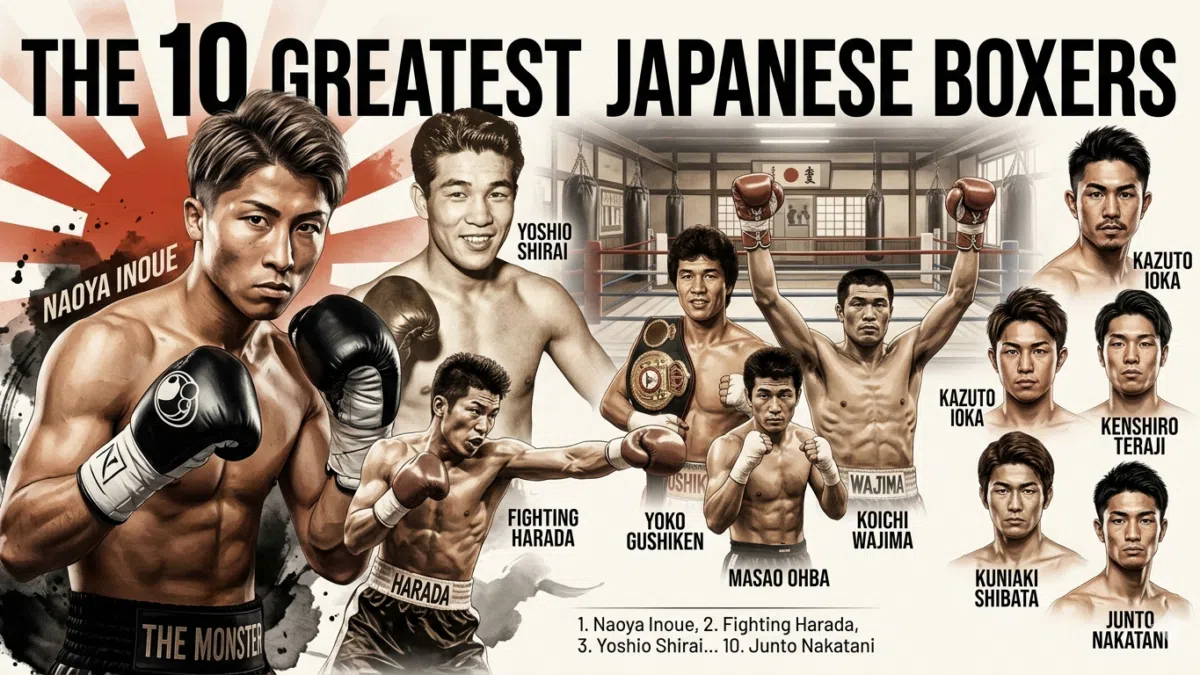
Japan ranks fourth worldwide in total boxing world champions, behind only the United States, Mexico, and the United Kingdom. From the post-war breakthrough of Yoshio Shirai to the current dominance of Naoya Inoue, Japanese boxing has produced some of the most technically gifted and exciting fighters the sport has ever seen. Here are the 10 greatest.
1. Naoya “The Monster” Inoue
There is no debate. Inoue is the greatest Japanese boxer in history and one of the greatest fighters of any era. He became the undisputed bantamweight champion by knocking out all four titleholders, something no fighter in any weight class had ever done. He then moved up and became undisputed at super bantamweight. He holds the highest knockout rate in world title fight history at over 90%. The Ring named him the #1 pound-for-pound fighter in the world, a first for any Japanese boxer. He is still active, still undefeated, and still terrifying everyone in front of him.
2. Fighting Harada
Before Inoue, Fighting Harada was the standard. Born Masahiko Harada in 1943, he became a two-division world champion in the 1960s, winning titles at flyweight and bantamweight. His victory over the legendary Eder Jofre, widely considered one of the greatest bantamweights ever, announced Japanese boxing to the world. Harada’s relentless pressure style and iron conditioning made him a nightmare for anyone in front of him. He was inducted into the International Boxing Hall of Fame in 1995 and Ring Magazine ranked him 32nd on their list of the 80 best fighters of the last 80 years.
3. Yoshio Shirai
Every Japanese boxer who has ever laced up gloves owes something to Yoshio Shirai. In 1952, just seven years after the end of World War II, Shirai defeated Dado Marino to win the world flyweight title and become the first Japanese world champion in boxing history. It was more than a sporting achievement. In a country still rebuilding from the ashes of war, Shirai’s victory was a moment of national pride that helped establish boxing as a major sport in Japan. He defended his title four times before losing it in 1954.
4. Yoko Gushiken
Gushiken was a phenomenon in 1970s Japan. He won the WBA light flyweight title in 1976 and defended it 13 consecutive times over five years, a run of dominance that made him one of the biggest sports stars in the country. His fights drew enormous television ratings and his technical skill at 108 pounds was remarkable. Fighting out of Okinawa, Gushiken brought boxing to parts of Japan that had never produced a world champion before. He retired in 1981 with a record of 23-1 and remains one of the most beloved athletes in Japanese history.
5. Kazuto Ioka
Ioka is the bridge between eras. He became the first Japanese boxer to win world titles in four weight classes: minimumweight, light flyweight, super flyweight, and flyweight. Still active and competitive well into his thirties, Ioka has fought at the highest level for over a decade. His longevity and versatility across four divisions put him in rare company not just in Japanese boxing but globally. He has shared the ring with some of the best fighters of his generation and consistently proven he belongs.
6. Masao Ohba
The “Eternal Champion.” Ohba won the WBA flyweight title in 1970 and defended it five times with a combination of skill and heart that made him one of the most exciting fighters in the world. Then, in January 1973, at the age of 23, Ohba was killed in a car accident. He died as the reigning champion with a record of 35-2-1. His story is the most heartbreaking in Japanese boxing history. He never lost his title. He never got old. He never declined. He was simply gone, and Japanese boxing lost a fighter who might have become its greatest.
7. Koichi Wajima
Wajima was one of the biggest stars of the 1970s golden era of Japanese boxing. He won the WBA super welterweight title and became famous for the dramatic way he won and lost it, trading the belt back and forth in memorable fights that captivated the country. His bouts drew massive television audiences and his name became synonymous with the wild, unpredictable nature of championship boxing. Wajima fought 50 professional fights and was a central figure during the most prolific period of Japanese boxing.
8. Kenshiro Teraji
Teraji was the dominant light flyweight of his era, holding the WBC and WBA titles and making multiple successful defenses. He served as the bridge between the generation that came before Inoue and the current wave of Japanese talent that includes Inoue, Nakatani, and Ioka. Teraji’s technical precision and consistency over years of championship-level fighting earned him respect as one of the best 108-pound fighters in the world. His reign helped set the stage for the current golden era of Japanese boxing.
9. Kuniaki Shibata
Shibata was a two-division world champion in the 1970s, winning titles at featherweight and super featherweight. He captured three world championships across those two divisions during a career that spanned the late 1960s through the late 1970s. Known for his technical boxing style and resilience, Shibata competed in an era when Japanese fighters were establishing themselves as legitimate forces in the higher weight classes. His achievements helped broaden the scope of Japanese boxing beyond the flyweight and bantamweight divisions.
10. Junto Nakatani
Nakatani represents the future. The current WBC bantamweight champion is a devastating puncher who has emerged as one of the most exciting fighters in the sport. His knockout power at 118 pounds is rare, and his rapid ascent through the rankings has positioned him as the next face of Japanese boxing after Inoue. Including him on this list alongside legends is a statement about where Japanese boxing is right now: deeper, more talented, and more globally competitive than it has ever been.
Honorable Mentions
Kosei Tanaka became the fastest four-division champion in history at just 21 fights. Takuma Inoue, Naoya’s brother, holds the WBA bantamweight title. Guts Ishimatsu won the WBC lightweight title and became a popular television personality after retiring. And the list of Japanese champions continues to grow every year.
Japan’s boxing tradition is built on discipline, technical precision, and a willingness to fight the best in the world on their own soil. From Shirai’s breakthrough in 1952 to Inoue’s dominance today, the thread has never been broken.